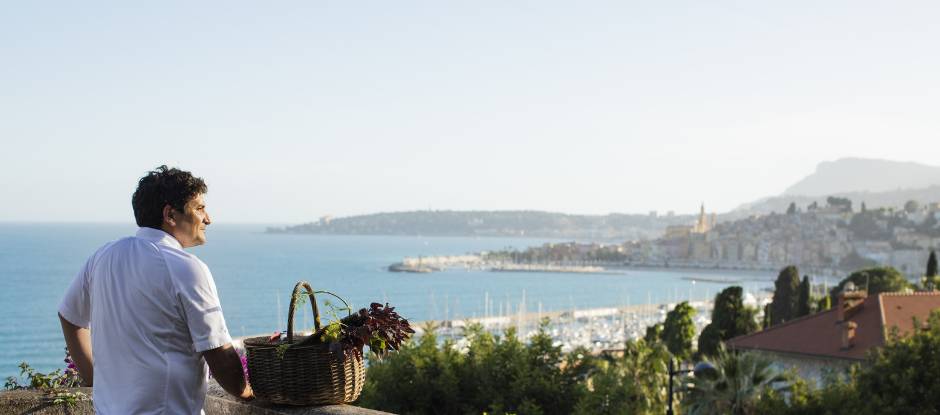
The legendary chef behind Mirazur on the tragedy that shaped him, the restaurant's milestone anniversary and the cultural change rocking kitchens.
Mauro Colagreco has come a long way. Born and raised in Argentina, he moved to France at 23 to study gastronomy and went on to work in some of the country's best kitchens. In 2006, he arrived in Menton – a pretty town on the border of France and Italy – where he opened Mirazur. Within a year, the restaurant earned its first Michelin star; from then on, the awards kept coming, culminating in Mirazur being named The World's Best Restaurant 2019.
Yet despite all the accolades, Colagreco is humble. When asked to describe himself, he hesitates before smiling and stating simply: "I'm a chef".
Back to the beginning
The first few lines on Colagreco's CV read like a who's who of French cuisine. He worked first for Bernard Loiseau at Le Relais Bernard Loiseau, then spent time at both l'Arpège and Hotel Plaza Athénée, working with Alain Passard and Alain Ducasse respectively. "No matter what sector you work in, learning alongside the very best is always rewarding," he says. "If they had anything in common, it was a deep respect for produce and for producers."
It may have been an enriching period, but it was not without its darkness. "Some of my most beautiful and most impactful moments were with Bernard Loiseau," he reflects. Loiseau died by suicide in 2003 and it has been speculated that his death was linked to the extraordinary pressure of chasing and maintaining the culinary world's highest accolades.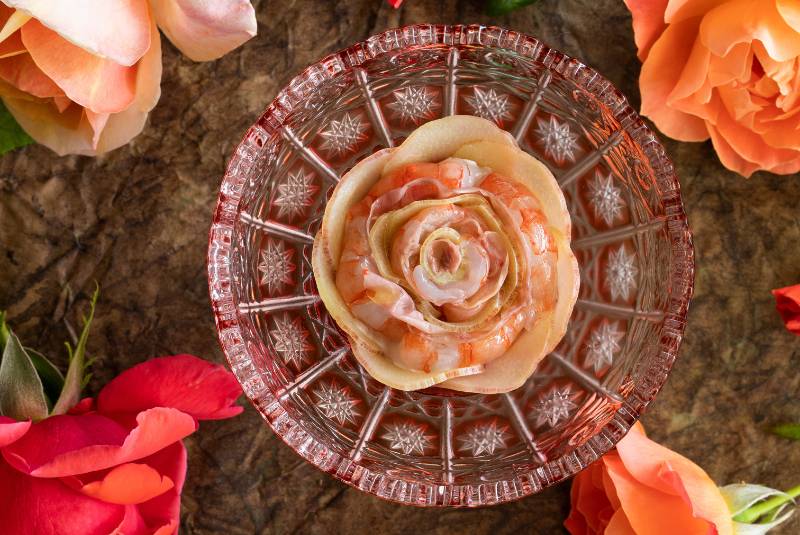
This dish – a rose of rhubarb and prawns – is part of Mirazur's Universe Fleurs menu, which celebrates flowers (Image: Matteo Carassale)
"I had a very beautiful relationship with Bernard," he continues. "[Loiseau's death] was a very important lesson for me. I promised myself I would always remember why I cooked.
"It's not about prizes or guides. I cook because I love it and because I love people – when you cook, it's an expression of love."
A new approach
At Mirazur, Colagreco developed the concept of 'circular gastronomy'. "I borrowed this term from the idea of a circular economy," he explains. "It's simple, really: it's about working with natural cycles and trying to understand the ecosystem of which the restaurant is a part.
"We're not the only team doing this; there are lots of restaurants with this approach who have achieved great success, like Central [the Lima restaurant led by Virgilio Martínez, named The World's Best Restaurant 2023]."
This concept also encompasses the social side of a restaurant too, with implications for diners, staff members and producers alike. "We have to be conscious that what we're cooking has a direct impact on the natural world, but also on the people we're feeding," he says.
Acknowledging the bad...
In recent years, Colagreco has seen a shift in what new team members expect of their time at Mirazur. "These days, young chefs come to work at my restaurant and they have needs that my generation never had, and they ask questions we never asked."
When working at the highest level, there will always be a certain demand on staff, he concedes. "It's the same in any profession. To be among the best in your field requires a great deal of rigour and concentration, but that doesn't mean that management should be endangering staff wellbeing. We need a management style that is right for this day and age."
Mirazur has moved with the times. As well as improved financial benefits for staff, the restaurant now hosts staff yoga classes every Sunday and the team can access regular osteopathy appointments, helping team members deal with the physical strain of working in a kitchen.
He admits that he didn't always get it right. "I've made a lot of mistakes, but you learn throughout your career. You learn how to control your emotions, cope with stress and put things in perspective."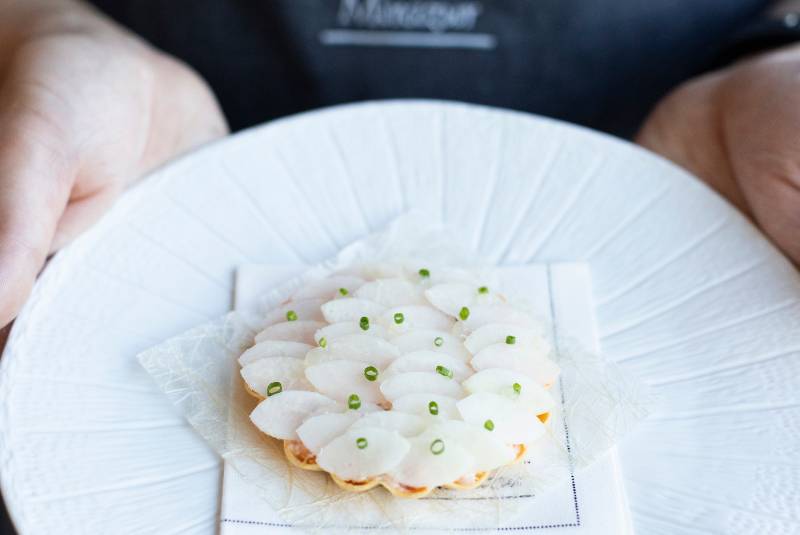
A turnip and lobster tart, part of the Universe Racine menu, which focuses on roots (Image: Matteo Carassale)
When asked about recent discussions of mistreatment in famous kitchens, Colagreco restates the importance of moving towards fairer treatment of staff across the industry, but he hopes this can be a journey that includes everyone, even those whose record is far from perfect. "I don't want anyone to be burnt at the stake for their mistakes," he says. "It's very human to make mistakes. What's important is that we help people change."
...and celebrating the good
This year marks the 20th anniversary of Mirazur, a milestone the team celebrated in spectacular fashion. For the 10-year anniversary, Mirazur played host to 10 of the world's most celebrated chefs, including Virgilio Martínez, Massimo Bottura and Alex Atala, who each created menus celebrating what they saw to be the essence of Mirazur.
Ten years on, the team was determined to top this celebration. "We realised that all those chefs we'd invited 10 years ago had something in common: they'd all been part of a wave of chefs proving that fine dining didn't have to be French cuisine. We asked ourselves where this shift had started, who had opened the door for this group of chefs who were doing their own thing? Without a doubt, that person was Ferran Adrià."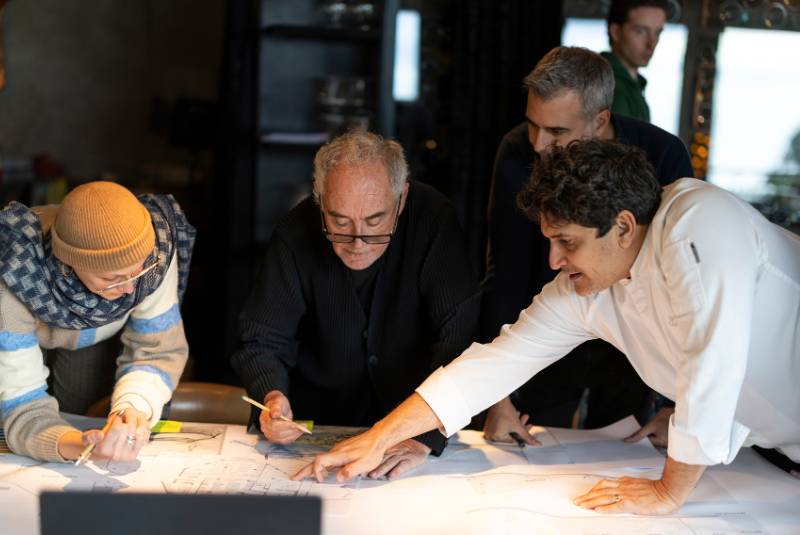
Ferran Adrià [middle] and Mauro Colagreco [right] work with their teams to devise the anniversary menu (Image: Matteo Carassale)
Until its closure in 2009, Adrià was the head chef of El Bulli, the game changing restaurant on the Catalan coast which was named The World's Best Restaurant an impressive five times. "At 23 years old, I showed up at El Bulli with my CV in my hands, hoping to do an internship." While Colagreco never ended up working at El Bulli, the restaurant nevertheless left its mark. "When I ate there, I was stunned," he says. "It was Ferran's willingness to break all the rules that struck me most."
Even for a chef of Colagreco's stature, a collaboration with Adrià was not a guarantee. "We knew if we just offered him a collaboration dinner, he wouldn't accept. We had to come up with something more interesting."
In the end, the team invited Adrià to take on the role of gastronomic curator, shaping a menu in the same way a gallery curator selects pieces from an artist's body of work and arranges them into a cohesive narrative. This innovative approach to collaboration piqued Adrià's interest.
Divided into five acts, the menu brought together reimagined versions of iconic Mirazur dishes and plates that examined El Bulli's legacy, which the Mirazur team explored by visiting several ex-El Bulli chefs (including Albert Adrià and José Andrés). "It was a challenge, but a very beautiful one," he says. "Not everyone gets the chance to reflect on their career so profoundly.
"We surprised ourselves with what we are able to pull off," he continues. "And we were surprised by the reaction of our diners. Guests got emotional: some of them had always wanted to visit El Bulli but never managed to go. It was an incredible experience."
Leaving a positive legacy
At this stage in his career, Colagreco has moved into a new phase. Spending less time in the kitchen has allowed him to take on new responsibilities. "These days, what motivates me is education. I want to get the message out that gastronomy at the highest level doesn't have to be destructive."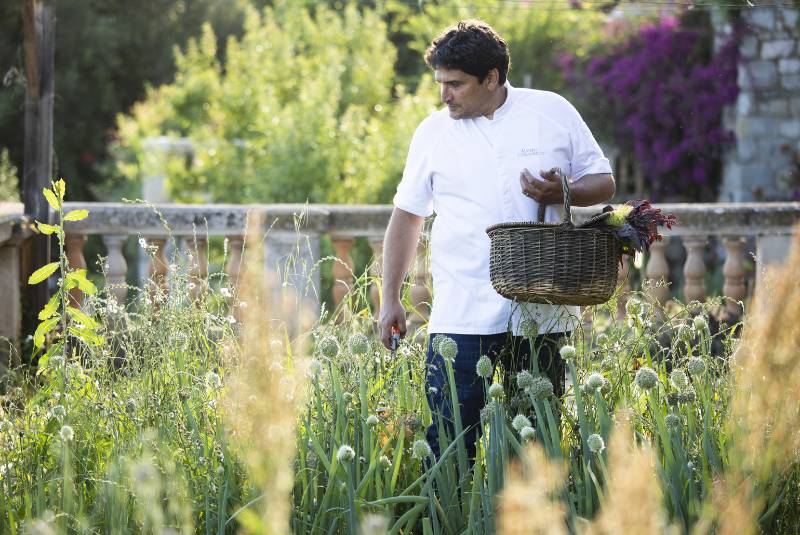
Mirazur is famed for its scenic gardens (Image: Matteo Carassale)
In November 2022, Colagreco was appointed as Unesco's Goodwill Ambassador for Biodiversity. It's a natural fit, with the organisation's aims chiming with the principles of circular gastronomy.
One of the projects he describes will take place in France's La Moselle biosphere, where children from kindergarten to high school will learn about food from a nutritional, environmental and social perspective.
"I think my generation was one of the last who learned to cook from our parents and grandparents," he says. "That generational knowledge is so important and it's being lost."
It can be easy to be cynical about titles such as this, to question the chef's involvement and wonder if it has more to do with positive press than a genuine desire to do good – but Colagreco's passion and conviction shines through.
"It's not just an honorary title: it's a solid commitment from Unesco, from my team and from myself," he insists.
"I feel proud, I feel honoured, but I also feel a great deal of responsibility."
Discover more stories from The World's Best Restaurant Award winners with our series on the Best of the Best.