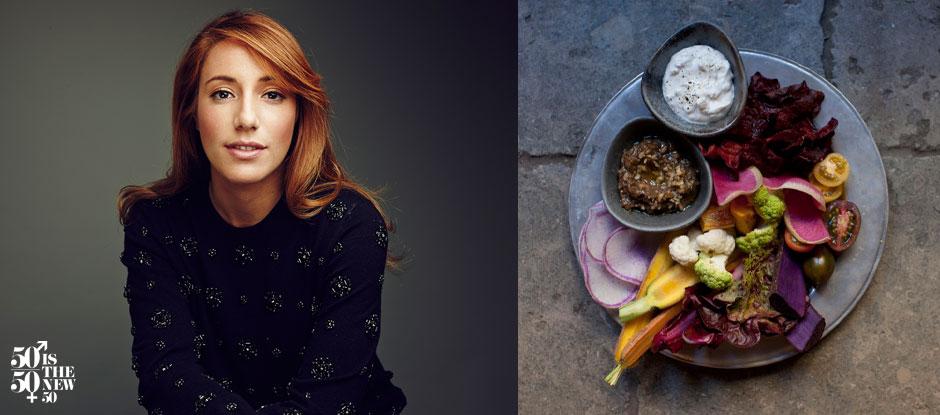
Camilla Marcus is a ground-breaking chef, entrepreneur and advocate on a mission to forge a better future for the restaurant sector. After being forced to close her New York restaurant, West~bourne, as a result of Covid-19’s widespread impact, she opens up about the challenges the community is facing and why she still believes in her vision for a more sustainable hospitality world
Camilla Marcus describes the hospitality community as “the people who think the impossible is possible”. Never has such a statement rung truer than in 2020, when restaurant and bar businesses around the world have faced more restrictions, government-mandated closures and challenges than in any other recent times. Yet Marcus – along with millions of other unnamed cooks, restaurateurs, kitchen porters, operators, business owners and hospitality workers in the US and beyond – is refusing to throw in the towel.
The creator of one of New York’s most socially conscious and forward-thinking restaurants, Marcus was forced to shutter West~bourne’s physical location in SoHo, Manhattan, in September after her attempts to negotiate a fair rent during the closure failed. “Think about your income pre-pandemic,” says the 35-year-old chef. “Now, all of your expenses have to stay the same – your kids have to go to the same school, you can't trade out your car, you can't move, nothing in your life is structurally allowed to change, except you haven't had your income since March. Most individuals could not even possibly fathom that scenario. And yet, millions of people and businesses are being affected just like that.”
It's a dire situation for the hospitality sector, but not one that would dishearten Marcus. In her training years, she studied at the French Culinary Institute at night while working at Dell’Anima by day, and since the start of the pandemic, she has refocused the West~bourne brand to include online retail, packaged provisions and curated culinary experiences. The rest of her time is dedicated to Relief Opportunities for All Restaurants (ROAR) and the Independent Restaurant Coalition (IRC), both of which she co-founded, as well as environmental activism and advocating for structural reform in the industry.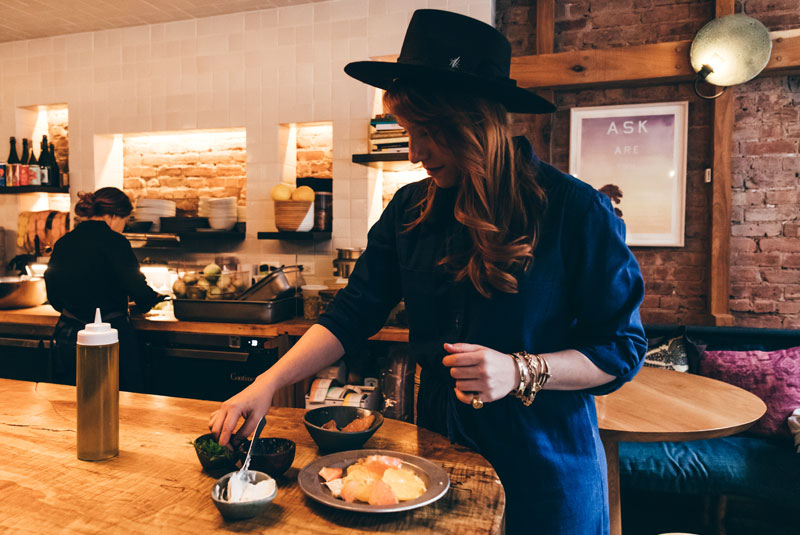
Marcus at the now-shuttered West~bourne (image courtesy of Camilla Marcus)
ROAR, which supports restaurant workers in New York, and the IRC, which works at national level, have long been pushing for Congress to pass the Restaurants Act, which would establish a $120-billion Restaurant Revitalisation Fund allowing independent hospitality businesses – such as West~bourne was – to receive a bail-out to support them through the current crisis.
“It’s critical financial relief,” says Marcus, who obtained a JD/MBA from the New York University before joining Danny Meyer’s Square Hospitality Group, where she worked on business development. “Opening and closing – we understand the need to do that for public safety. Restaurants are in the business of public safety. But we also need support for what the business is supposed to do when we're asked to be closed. We're just asking for support commensurate with what we've sacrificed and what we contribute [to the economy], and it's very disappointing to see that we still haven't made progress,” she continues.
As restaurants in New York begin what may well be their hardest winter yet, Marcus thinks back to March, when all hospitality venues were first asked to close. With whole streets shut down, the city lost many of its centres of community, vibrancy, heritage and diversity. But at the same time, the values that many food and drink venues uphold found other channels on which to shine.
“When the pandemic first broke, we were feeding people on the frontlines,” she says. “People risked their lives to feed those in need, as well as the healthcare workers working around the clock to protect and save us. This is the greatest community of humans I have ever had the privilege of knowing and working with. Chefs and restaurateurs across the country came together within 24 hours to say: ‘We can't go down like this. We need to do something about it.’”
View this post on Instagram
ROAR and the IRC are urging people and companies across the country to join in the fight to save restaurants by donating to their appeals, calling on government representatives to sign the Restaurants Act, and signing letters urging Congress to pass restaurant relief. Nine months into the coronavirus pandemic, there is still plenty that any individual can do to help one of the hardest-hit sectors.
“This is a time to not be isolated, it’s a time to come together,” adds Marcus. “It’s a time to say: ‘For every reservation that person gave me last minute, for every celebration I remember at a restaurant, there is something I could do.’ Whether it's for five minutes or an hour, if you can dedicate your time, dedicate some of your resources and focus [to help save restaurants], it will go a long way.”
A sustainable revival
When Marcus opened West~bourne in 2018, it was essential for her that the restaurant provide an alternative role model for what a delicious, sustainable and socially conscious hospitality business could look like. The venue that was born was zero-waste, focused on plant-based dishes, hired staff from a youth empowerment non-profit – which it also regularly donated to – and offered fully subsidised childcare for employees. In many of these aspects, the arrival of the pandemic represented a forced step back for the industry.
“Sustainability has been a more complicated set of circumstances in the wake of the pandemic,” she comments. “The immediate panic and concern for health and safety understandably shifted things back to single-use plastics, non-sustainable chemicals and thinking about sanitation first. But I hope that what comes out of it is a push back.”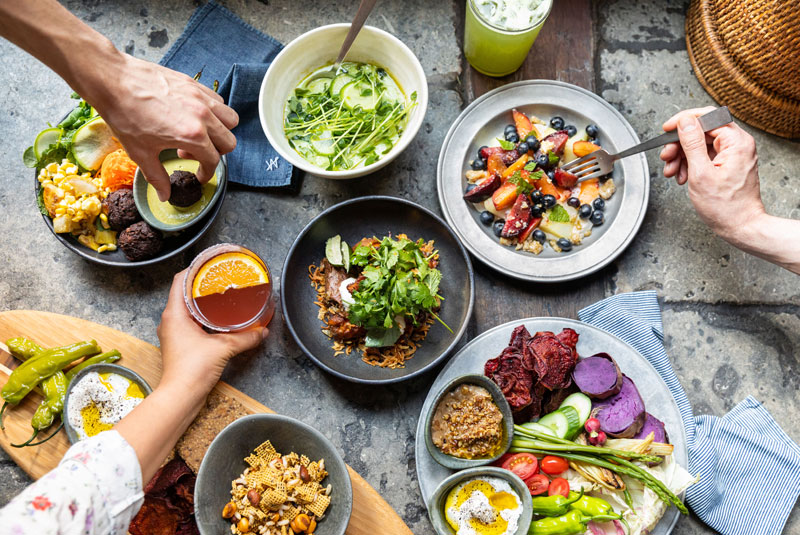
A spread of West~bourne dishes and drinks (image: Nitzan Rubin)
Marcus, who grew up in Los Angeles, was shocked when she moved to the East Coast aged 18. She highlights that New York still doesn’t have city-wide composting, unlike LA, and was surprised to realise that the West Coast’s sustainable ethos hadn’t proliferated across the country. Since then, she has been on a mission to show that being sustainable is within the reach of anyone who’s willing to try.
“The sky's the limit with what restaurants can do as far as sustainability goes, how we take care of our guests as well as hopefully influence their choices at home with their own families,” she says. “There are so many choices, big and small, that a chef and restaurateur can make, whether it's at the start of creating a new concept or retro-fitting one that's already in operation.”
Some of the areas she suggests considering when undertaking a sustainability-focused restructure include menu engineering, incorporating by-products into new culinary creations, and assessing sourcing, suppliers and agricultural practices. But she also doesn’t believe that the responsibility should fall on independent restaurants alone.
“Right now, there’s a big gap between what some consumers, restaurateurs and chefs are hoping to be the sustainability baseline, and what the government is encouraging and incentivising,” she says. “Over the last five to 10 years, we’ve seen trailblazing chefs and restaurateurs deciding on their own to make that investment because it's in their heart and they believe it's right. But it is time for government, publications and award bodies, as well as guests, to place a higher value on it, to come along on the journey and to share that responsibility.”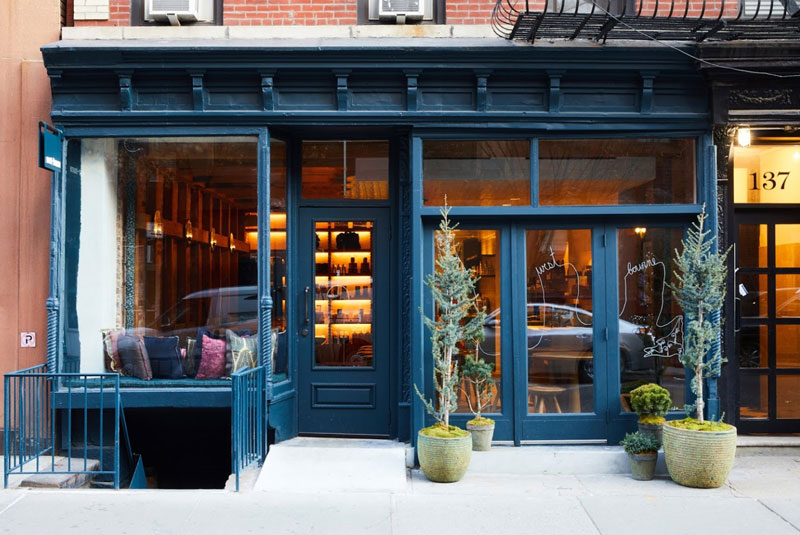
West~bourne in SoHo, Manhattan (image: Nicole Franzen)
Marcus readily admits that in 2020 sustainability can still seem like a luxury. Often, the most sustainable solution isn’t the cheapest – and therefore it also isn’t the most lucrative for a business. But her belief is that it should become the new base standard.
“It's going to take our community, the public and our guests to push for this and understand the true cost of putting thoughtful food on a plate. Then, we have to pressure our government to change the structure,” she states. “I do think there's a growing awareness, with the rise in popularity of cooking, the proliferation of local green markets and the increased popularity of restaurants and chef culture. This can influence things two ways.
“The first is: you vote with your dollars. You choose what to value. People flock towards demand – that’s a strong influencing force. The second is thinking about who you vote for as your representatives, who you put in power, especially locally. People underestimate how much our society, communities and culture are influenced by local and state lawmakers,” says the restaurateur.
As she exemplified at West~bourne, Marcus is also a believer that moving towards a predominantly plant-based diet and seeing food through a wholesome lens are other essential steps towards a more sustainable food system. “I recently read a CNN headline story about the flu season and potential future waves of Covid-19, and nowhere in the article did it talk about how you can take care of yourself and stay healthy by looking at how and what you're eating,” she comments.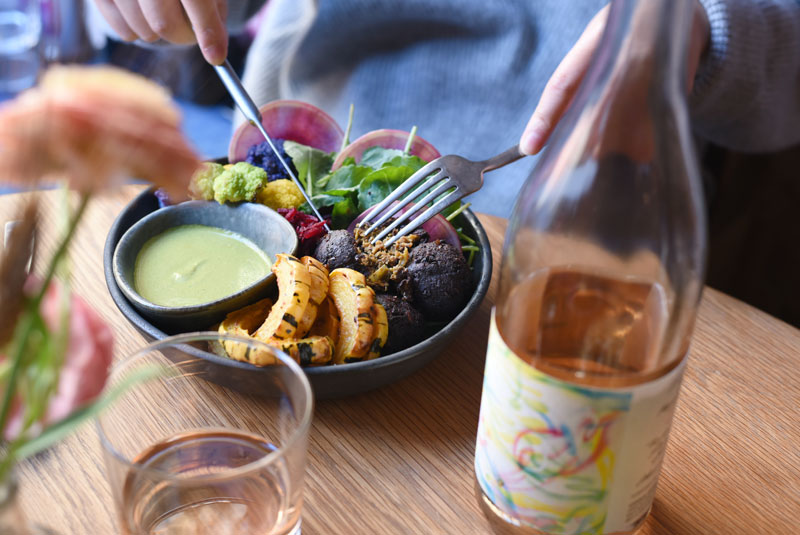
Over the Rainbowl (image: Danielle Adams)
From this point of view, the issue is also one of dissemination in the media. “Where is the cover story about zero-waste Thanksgiving?” she asks. “Publications and accolades have a real responsibility to shine a light on restaurants that have certain values that matter. They get to decide what is important, what's applauded and what is highlighted to guests and travellers around the world. We have to think about whether we are promoting enough chefs, restaurateurs and people who are trying to think more plant-based and make that part of their restaurant practice.”
A more sustainable future will be the result of widespread cultural changes – and Marcus believes we all have a part to play in making it part of the zeitgeist. Having faced some backlash around the opening of West~bourne as a zero-waste brand, she has remained firm in her belief. “Anything worth pursuing, anything worth pioneering, is going to be doubted and challenged,” she says. “It's not going to be a straight line or an easy road, but I always think that easy is boring. I think you have to do what's in your heart and what you feel is right, and not worry about what the crowd thinks.”
Header images: Marcus (portrait: Benjamin Rosser) and The Bounty (image: Lexie Moreland)
‘50/50 is the new 50’ is a content series created by 50 Best and supported by S.Pellegrino with the shared aim of promoting equality, inclusivity and balance in the hospitality sector and beyond.
In October, Marcus took part in the 50 Best Recovery Summit, which featured nine inspiring sessions in a variety of compelling formats, now all available to watch on demand, for free, anywhere around the world. See the full playlist on Facebook and YouTube and follow 50 Best on Instagram and Twitter for the latest news.