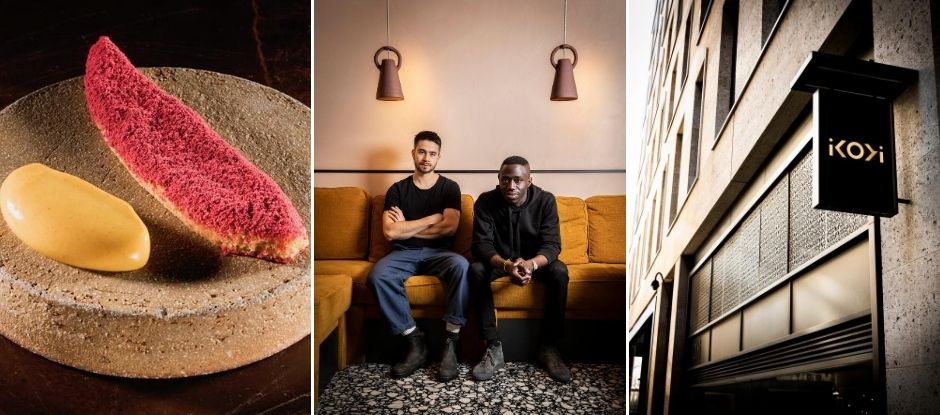
As Iré Hassan-Odukale heaved the first suitcase loaded with Nigerian pink peppercorns onto the luggage belt at Lagos airport in 2017, he pioneered an approach to ingredient sourcing that has become the lifeblood of his restaurant. With the thud of leather onto revolving rubber, followed by its ingestion into the bowels of the airport’s luggage transfer system, it proved an agricultural yet effective way of ensuring his chef partner and co-owner Jeremy Chan could have the ingredients that would see Ikoyi become one of the few truly unique restaurants operating today.
Three years on, reams of positive column inches and countless research missions to gastronomic frontiers behind them, the humble suitcase remains their mule for success. “It’s still one of the most reliable methods to get us what we need,” says Chan jovially from the dining room of his restaurant one week on from opening after lockdown in the UK. “I find it mind-boggling to think that, sitting over there, we had Alain Ducasse at the table being complimentary about the smoked peppercorns that had just arrived in a suitcase from Lagos the previous day.”
The lengths to which Hassan-Odukale and Chan go to source produce underpin the restaurant’s ideology. “We want to work with the best, and will go to great effort to find it,” confirms Chan. “All manner of peppercorns and spices we work with come from Nigeria, Sierra Leone, Senegal, Cameroon. But it’s not all just African-led ingredients. We look to Vietnam, Thailand, Cambodia, India and its various states.”
Every dish on Ikoyi’s menu contains chilli in one form or another and this has become a signifying trope that defines its style. “Chilli is built into the flavour profile and runs across all stations in the restaurant, from the larder to pastry. It’s not all ‘hot’ spicy, though. There will be flavours discernible as spice, but they don’t always come through as chilli-based heat.
“Ikoyi is a lifelong search for the best produce we can find in our area of reach, treated with respect, integrity and passion. The restaurant looks to optimise natural flavours of ingredients while adding our own personality, which is certainly found in spice and a range of other characteristics.”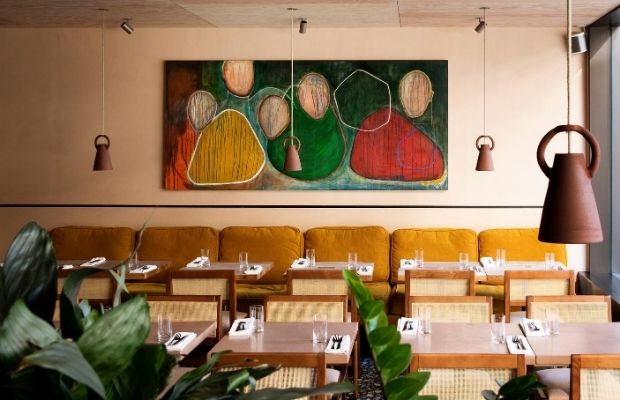
Ikoyi's interior pictured pre-lockdown. The restaurant is located in St James's Market, London
In search of categorisation
Journalists and diners alike have struggled to define Ikoyi; it doesn’t fall neatly into any of the gastronomic boxes we have become accustomed to in recent years. There are influences from a modern European style of plating; elements drawn from north and sub-Saharan Africa in terms of ingredient use; Asia has a hand in cooking techniques; and there are hints of North American tradition in cooking styles and menu description. When a restaurant is difficult to categorise and the dining lexicon doesn’t have the adjectives to describe it, all too often, according to Chan, commenters resort to type.
“I struggle with people wanting to give labels to Ikoyi,” he says. “Why can’t we think freely with food like we do with art? How would you verbalise Jackson Pollock, for example? So many contemporary artists are uncategorizable. Everyone can agree that it’s beautiful, stimulating and meaningful – can’t food be like that?
“I consider myself a pure creative. I like innovative ideas and we respond well to new concepts without having to define them as British, Chinese, or whatever. Unfortunately, restaurant categorizations can be inaccurate.”
Chan’s creativity is without question. A successful academic career culminated with a degree in philosophy from Princeton University, New Jersey, before he returned to the UK to develop his skills as a chef. Nigerian-born Hassan-Odukale similarly graduated from university and pursued a successful career as an insurance underwriter in the City of London. The two men had met at sixth-form college and started a friendship that would last 15 years before they came together to launch their restaurant.
Ikoyi’s name is borrowed from a province in the Nigerian city of Lagos, which goes some way to explain why food writers have been keen to apply the ‘West African’ tag. Chan spent months in the British Library studying the nuances of African and Asian food and developed a style of research-led thinking that informed the restaurant’s opening menus. Ever since, he applies a cerebral, empirically driven process to creating dishes.
“I approach food in a similar manner to the way I would an essay for university,” he says. “It’s a very researched, thoughtful process. For example, if I’m going to make a rice dish, it’s not just a case of how we’re going to cook the rice and get a chicken flavour into it. It’s about working out the different stages of its cooking, linking it to the peculiarities of our kitchen and how the recipe will react to our ovens and the temperature the kitchen will be when the rice comes out of the oven. Once I’ve considered all the variables, I will write it down to the gram and millilitre and then cook it.”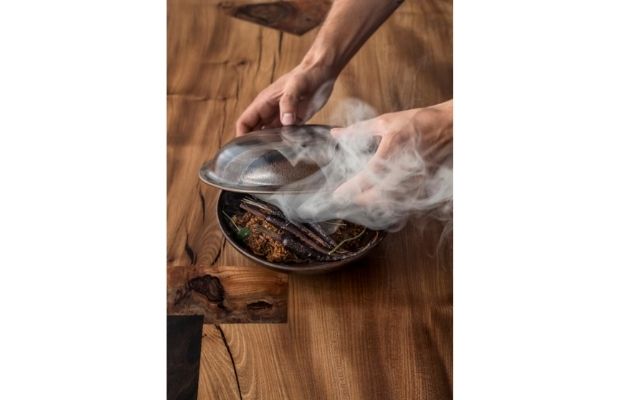
Ikoyi's legendary jollof rice from the pre-lockdown menu
“It’s great to watch Jeremy work and see the creative process,” says Hassan-Odukale. “Jeremy will just talk about a dish and the next thing I know I’m presented with it. Sometimes I’ll make a suggestion here and there, but in the main, I’ll leave Jeremy to it.”
Hassan-Odukale’s role in the restaurant is “to do everything outside the kitchen”. He runs the HR, procurement, finance and marketing. “Obviously I’ll enlist Jeremy’s help when he can get out of the kitchen, but it’s pretty much just the two of us doing everything – crazy, right? We basically spent the whole of lockdown on the phone to one another talking about what we wanted the restaurant to become. It was great to feel as though we had time to take stock as we prepared to open again.”
A new menu in a post-pandemic world
The pair were planning their vision of ‘comfort food’ interpreted through an Ikoyi lens. The new offering has shifted away from tasting menu format (though the team are trialling a simplified structure if a diner requests it). “I wanted to make fried chicken,” says Chan. “But how do I articulate what fried chicken means to Iré and me? The fried chicken I had as a kid growing up in Hong Kong had insanely tasty yellow fat under the skin and was really crispy. It’s nothing like the British chicken we get, which is plump and white.
“Once I’ve got the idea, next for me is to find the right product. I spoke to a woman who was supplying chicken to The Greenhouse in London. When I asked her if she could get the chicken with its offal still in place and its feet attached, I think she was suspicious. I also wanted an aged chicken that looked super gnarly and held way more favour. She introduced me to a farm in Gascony and the poultry they have is screamingly delicious.
“The leg is gamey and, as it has been working, it has a strong cardiovascular system with a lot of stress on the muscle. When you cook it, it arrives pink – almost like a large quail’s leg. When guests query the colour, sometimes we have to explain that it’s been cooked properly; that the bird has been steamed for three hours, salted, dried and then fried and rested in aromatic fat. We explain that we then season it with miso and dried fermented onions, so you’ve got the flavour from the lactic acid and the umami from the miso. But the last thing we want to do is to lecture about what goes on in the kitchen.”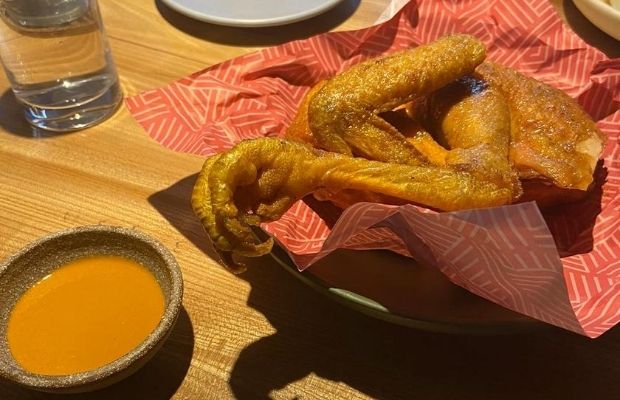
Fried Landes chicken, aged beef fat and chicken offal hot sauce
Ikoyi’s service style could be seen as relaxed, verging on the point of stand-offish. The antithesis of more didactic methods employed by other fine dining restaurants, it is a point of principle for Hassan-Odukale and Chan that they do not preach to guests about the genesis of everything that they are about to eat.
“It’s like going back to the food-as-art thing,” explains Chan. “Do you enjoy going to the new David Hockney exhibit and standing there reading the name card for half an hour? Or do you want people to stand back and soak in the experience? Unfortunately, there are a lot of people that do look at the name and just take a picture of the art. In our restaurant we are trying to curate an experience for people so that they can just focus on the food. However, I'd say 50% of the guests just get their iPhone out. They want to know what's in it; they want to get on Instagram. Although for those that do get what we are trying to do, it’s worth it.”
Hassan-Odukale has his own take: “It’s almost over the top, the technique that goes into each plate. It contains as much skill as any elite restaurant, but we don’t want to put it across in a way that makes people feel alienated. In terms of elevating the experience for the guest, it’s like we are trying to hide the work that has gone into it. Sure, some guests just don’t get it. They come here and equate a more stand-off service with a bad review and will complain once they leave because they haven’t received traditional ‘silver service’. To us, that means they’ve missed the point to our style, which is unpretentious and very detailed, but just not what they’re used to.”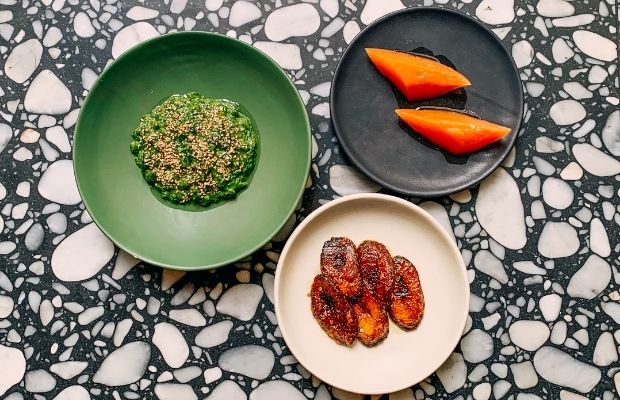
Three dishes from the new menu (clockwise from left): creamed spinach ehuru; Sun Sweet melon, peppercorns, chamomile and elderflower; plantain caramelised in ginger and kombu
A modern British restaurant?
A look into the tiny kitchen secreted in the back of the premises reveals two things: one, a sense of astonishment as to the quality of food that can emerge from such a miniscule space. And two, the international nature of the team’s brigade. “Anyone is welcome to apply to work here,” says Chan. “I just want someone who is willing to do the job. I think a lot of it comes down to what your cultural designation is perceived to be. A lot of British chefs apply to British restaurants, and a lot of their staff makeup looks kind of the same. Here, we get a huge mix of applications.
“We get a lot of Italians because they’ve seen us on MasterChef, but then we get a lot of Africans, Asians and a big proportion of people of colour, because Ikoyi seems to be the kind of restaurant that relates to people of colour. But it is certainly not diverse because we try to make it so. People will inevitably gravitate to the social group which is most akin to their understanding.
“I would actually argue that we are as British as any other restaurant. We might not have British signifiers on the menu – a sausage roll or a take on fish and chips – but the purity of thought and many of the ingredients we use come from this nation. We are championing British cuisine just as much as chefs who purport to be championing British cuisine but import wagyu beef from Japan and vegetables from France.”
Indeed, a deep dive into the new Ikoyi menu reveals a prominence of British producers. The team has just started working with a Cornish farmer who rears retired wool-producing sheep for the table. “We dig hard to find artisans that fit with our philosophy,” says Chan. “This guy who provides the sheep for our kebabs is really interesting. He takes the mothering sheep that are eight, nine or 10 years old that have been fattened on organic pasture. It’s far milder in flavour than mutton or hogget as older sheep lose a wool-secreting gland that gives the meat that distinctive smell and taste. It means you get a mild lamby flavour from a well-fattened piece of meat that’s been aged very carefully. We then grind cuts of shoulder, belly and fat into the most amazing kebabs using cooking techniques I honed after talking in great detail with a friend of mine in Iran.”
This sheep kebab is served with the restaurant’s signature jollof rice, crab custard and black truffle. Together, it creates a genre-bending dish which is a perfect example of what makes Ikoyi so hard to define.
An eye on the future
Despite the international critical acclaim for Ikoyi, Hassan-Odukale and Chan haven’t seen positive press transferred to a waiting-list only restaurant. “It’s funny,” says Hassan-Odukale. “If any other restaurant in London had received the amount of coverage we have had, you wouldn’t be able to get a table for months. But even though we are growing happily, you can generally call up and get a table for the next week.”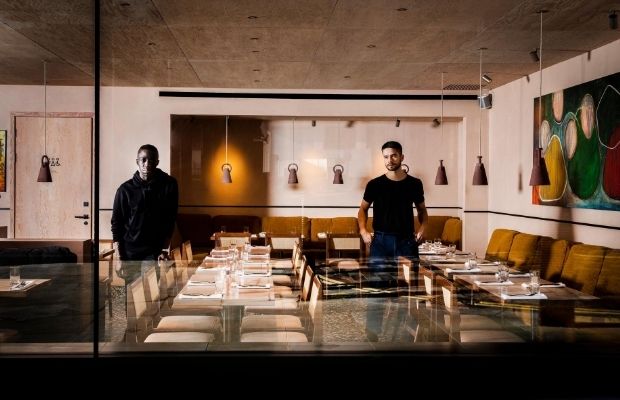
“If our restaurant was in New York, it might be a little different,” agrees Chan. “Even though we are a city of immigrants in London, everything is still rooted in British tradition and led by British ideas. New York seems to have more established immigrant traditions at the forefront of its food scene, but the way we are working is absolutely fine for us. It’s great to be ‘industry successful’ and I get the feeling that customers are now more understanding of what we do. I’ve got very good feelings about the next year, almost as if the recent months will birth a new breed of diner.”
Follow 50 Best on Instagram, Facebook, Twitter and YouTube to stay up to date with worldwide news and features on the hospitality industry.
Image credit: John Carey and Jeremy Chan