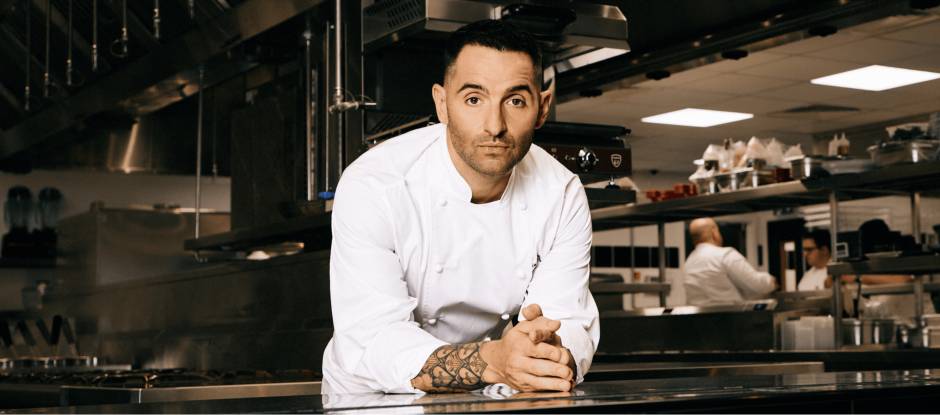
The architect of one of the hottest reservations in New York, Mario Carbone's refined Italian-American vision rewrote the rules of fine dining.
When Mario Carbone became a chef, it wasn't cool. In 1990s Queens, the Marco Pierre White-modelled rockstar chef era was in its infancy, and with TV shows such as The Bear and Boiling Point decades away, cheffing just didn't have today's cultural caché.
"I went years without really telling my friends that I [worked in restaurants] after school. It wasn't a cool thing to say," says Carbone. Undeterred, however, he went on to carve out a culinary niche that would redefine Italian-American cuisine.
In 2013, Carbone opened in New York's Greenwich village, taking over the site of Manhattan's oldest Italian restaurant, Rocco. All red brick and metal fire escapes with dark green awnings, a modern reworking of the original neon sign still illuminates the front of the dining room.
It was an instant hit (New York Times critic Pete Wells awarded it the publication's 'excellent' rating of three stars upon opening), with reservations still notoriously difficult to come by 13 years later. Not to mention the much-reported on celebrity guests occupying space in the restaurant's sultry corners.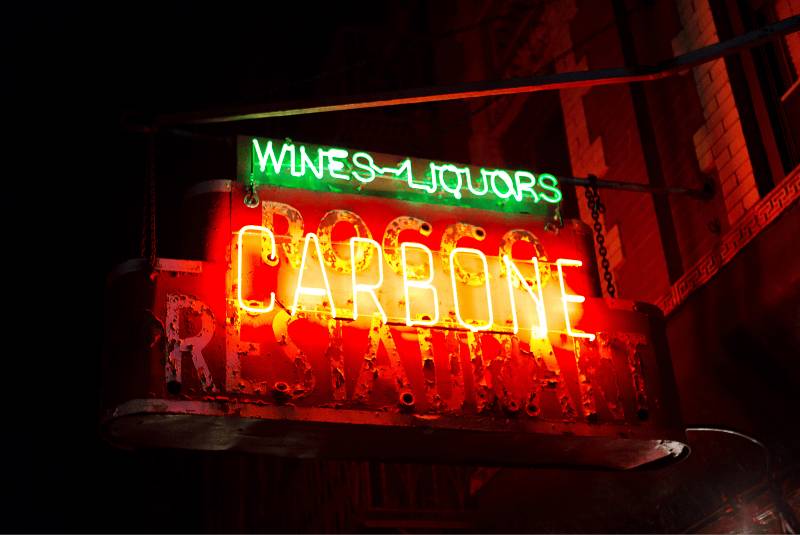
After 90 years of operating, Rocco closed in 2012, making way for a new era of Italian-American dining on Thompson street
"Growing up with Carbone-style restaurants was my inspiration. I remember one that's still open near where I grew up. We went for birthdays, anniversaries and to celebrate things. I would always get excited when my dad or mom would say, 'we're going there on Saturday'," says Carbone. "I wanted to pull little bits of their spirit. I wanted my menu to look like their menu, it's an homage to a genre, to this Italian-American, theatrical, fun dining experience."
Family first
Born in 1980 in New York to Italian-American parents, food was tantamount to ritual in the Carbone household. "We ate together; we communicated – it was a beautiful time. My dad was pretty regimented about dinner. Then on the weekends we would have more elaborate meals, and on Sunday we always had pasta," says Carbone.
His father is, unsurprisingly, a regular at Carbone. "It takes my dad 10 minutes to get to his table when he walks in because he says hi to absolutely f***ing everybody in the restaurant. It's ridiculous, but there are so many customers like that, it's beautiful."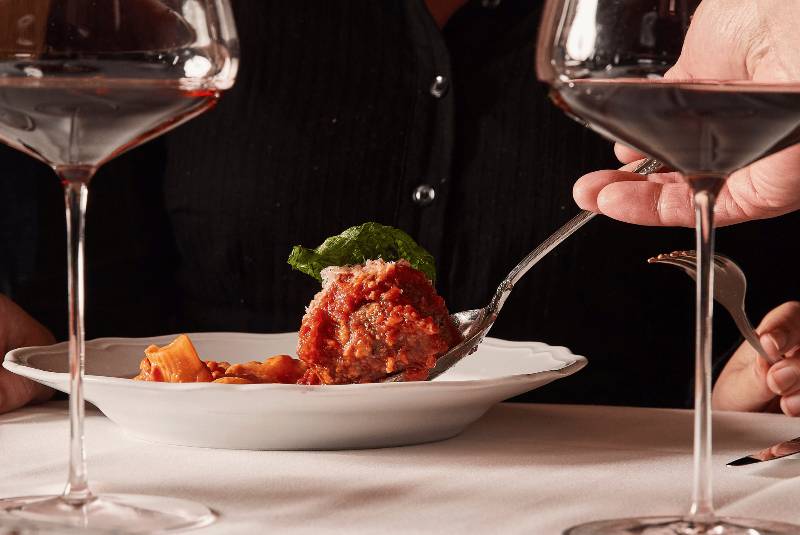
Carbone's famed off-menu meatballs are made with sweet Italian sausage instead of traditional minced pork for a distinct umami flavour
His grandparents, on his mother's side born in Italy and on his father's Brooklyn-based Italian-Americans, formed an important part of the picture. "My grandfather was an incredible chef. He would make the holiday meals for us so that was always wonderful. Every memory I have of him is in an apron."
Occasionally, the Carbones would visit one of the many Italian restaurants in Brooklyn, which in the 1980s was an area heavily populated by Irish and Italian immigrants. "I think my early love of the restaurant business was going as a kid to restaurants and being fascinated by the whole thing. I thought it was such a magic show that I could sit down, they could hand me a menu full of options, not knowing what I'm going to say, and behind those doors it comes out," says Carbone.
The early days
After graduating high school, Carbone, who admits he was never a traditional student, pursued a career as a chef, considering it a useful trade. In 1998, on his first day studying at the Culinary Institute of America, Carbone met Rich Torrisi, then a young chef who would go on to become one of Carbone's business partners, forming Major Food Group. Both from New York, the pair struck up a friendship, later becoming roommates. "Through living together in a very small New York apartment, we wound up divulging our dreams [...] and eventually we did them together."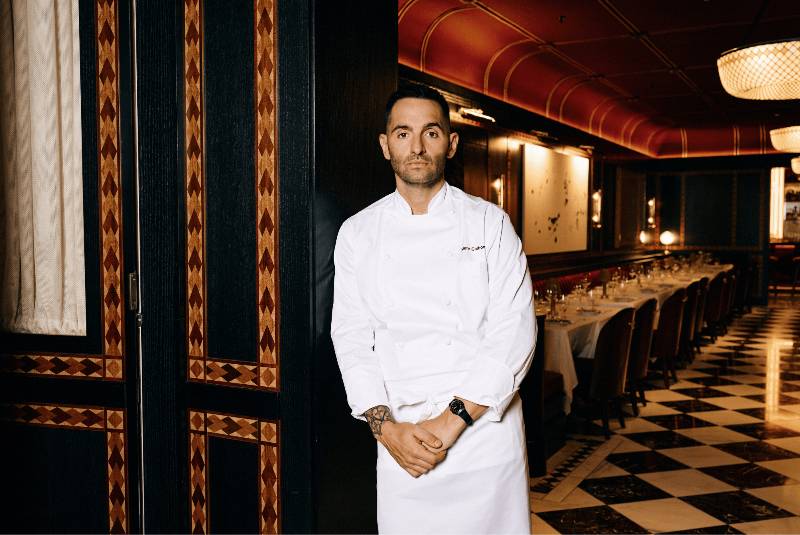
Carbone now operates in six countries, including Saudi Arabia and Qatar (image credit: Sofi Adams)
Together, the pair opened Torrisi Italian Specialties, slinging sandwiches in a tiny space that garnered queues around the block, before graduating to a full dinner service. Jeff Zalaznick, the third Major Food Group partner, was a regular in the early days. "He liked what we were doing, and he was like: 'hey, I think I could be helpful. I could be the third part of this company.' Rich and I just took a chance on Jeff. It's been the three of us ever since," Carbone says.
The apex of the trio's collaboration is arguably Carbone. When the original New York location opened in 2013, it offered diners a uniquely unstuffy experience, confidently reframing Italian-American classics to fine-dining status, all while bringing in the theatrics and dedicated hospitality seen in some of the city's best restaurants.
Movie magic
Modelled after popular New York 1950s red sauce joints, an experience at Carbone is all plush velvet banquettes, mosaic tiles and lacquered woods; generous plates of spicy vodka rigatoni fight for space on the table with tableside-prepared Caesar salad and oversized golden croutons, while Carbone's Zac Posen tuxedo-clad 'captains' tend to every possible diner whim.
"Carbone is Italian-American at heart. It's its own region of Italy, right? It has its own recipes, its own style of service," says Carbone. "I see it just like Tuscan, Venetian or Sicilian food. It's basic southern Italian dishes that have taken on their own form over 100 years of living in New York. The New York part of it is in its flair, how it's served. It's a whole style."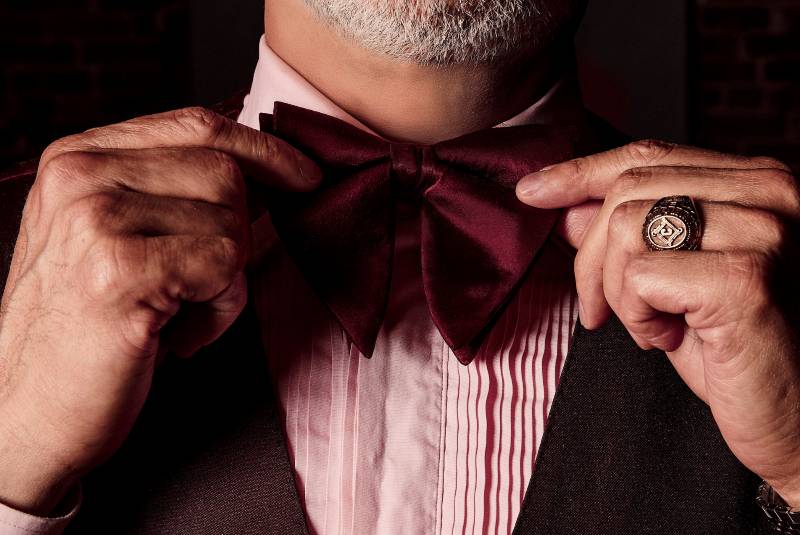
The captains at Carbone embody a service philosophy the restaurant calls abbondanza – an over-the-top spirit of generosity
The result of careful cultural curation and highly trained front-of-house staff is transportive. Carbone captured diners in a way reminiscent of today's 'viral' restaurants. "I see it like theatre," he says. "I want them to be transported. I'd like them to leave their life for a few hours and be an extra in my movie."
No-rules dining
While theatre is a key part of the operation, the chef is careful to state that this doesn't mean Carbone isn't without substance. "I would describe [Carbone] as fine dining. I don't think the environment should be indicative of whether it's a fine-dining restaurant or not. I think: did you buy the very best possible ingredients today? Were they prepared with excellence? Was it served with excellence? Is your wine list of quality? How are your cocktails? How was I taken care of? That's fine dining, whether Frank Sinatra is singing or you're in a tasting menu environment, it shouldn't matter."
This approach means Carbone doesn't always feel recognised by rankings or awarding bodies. "Maybe most rankings don't consider [Carbone to be fine dining], and that's OK," he says. "What I would hope from a list like The World's 50 Best Restaurants or Michelin is a dynamic list. When [the standard] is one dimensional, you end up being the populator of a trend. What I've always hoped for is a list where you can find excellence in more than one style of fine dining."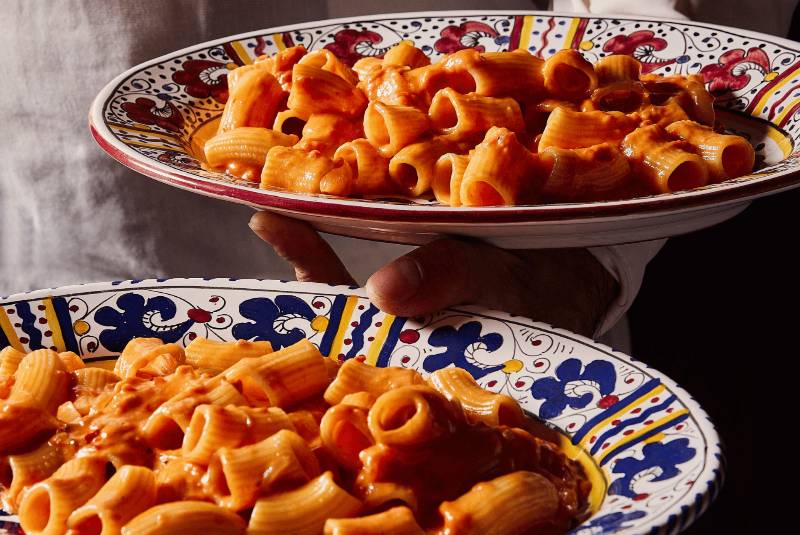
Dishes such as the spicy vodka rigatoni have become Carbone's comfort-meets-refinement calling card
Today, in a world where the global economic and political landscape make it difficult to run a restaurant, Carbone is flourishing. For the chef, this success is in part due to changing diner habits, and part astute business model. "I certainly think there's less desire today for the tasting menu restaurant. I just don't think it's wanted. You can see that because they're not really opening more of them," he says.
"[Carbone's] style of dining is offering a cheque average on par with the multi-starred restaurants of the world, but [we're] doing it in a way that people will come here more than once a week. Even if I absolutely loved that No.3 restaurant in the world, how many times am I actually going to go there? Our model is: 'I'll see you next Tuesday, Joe.' I want to be in that world," says Carbone.
London calling
In late 2025, Carbone opened its first London location. It had been a decade in the making, with Carbone reaching as far as Dubai and Hong Kong before landing in what could be described as New York's closest dining culture cousin.
"London's always felt comfortable to me, because as a New Yorker, it feels very much the same. It's kindred spirits," he says. "The theatre of it all is perfectly at home, especially in what is now the old American Embassy. There's nothing else quite like it in the city, which is hard to say in a place like London."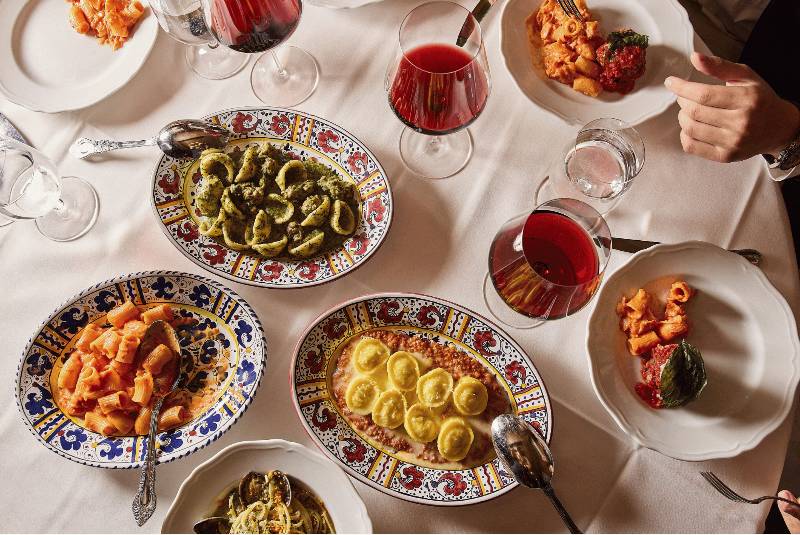
Carbone's London location has recently launched a new lunch menu with a seasonal focus
The clientele is just as star-studded as the famously glitzy New York and Miami locations, with Leonardo DiCaprio, Sean Penn and Kate Moss booking in for the famous 'spicy rig'. This and the expected 'hype' of a new opening means a table in Mayfair is just as hard to secure as in the original iteration.
However, Carbone reveals there are a few ways to (respectfully) game the system. "In the restaurants that do serve lunch, I think lunch is a great way to get in," he says. "I [also] often say if you happen to be in the neighbourhood, stop by in the early evening and see if there is any availability, because it does change during the night, so there are always possibilities for walk-ins."
And, of course, in a quintessentially New York fashion, a good word in the right place goes a long way. Carbone's parting advice? "Become best friends with your waiter..."
Header image credit: Sofi Adams
Carbone in New York is listed on 50 Best Discovery, where you can discover more fantastic restaurants, bars, hotels and vineyards for your next adventure.