From cooking with love to never chasing trends, the chef, mentor and visionary reflects on how his seasonal cooking philosophy forever changed the region's restaurant scene.
When Normand Laprise stepped onto the stage at the inaugural North America's 50 Best Restaurants 2025 awards ceremony in Las Vegas to accept the Icon Award, sponsored by Lavazza, the standing ovation was more than a tribute to the chef. It recognised a movement that Laprise has quietly and passionately led for more than three decades, shaping not only Quebec's restaurant culture, but contributing to the identity of Canadian cuisine and beyond.
These days, 'local' and 'seasonal' are buzzwords on most menus, but in 1993 when Laprise opened Toqué! in Montreal with business partner Christine Lamarche, these were radical concepts. Back then, Quebec's fine dining scene leaned heavily on French tradition and imported goods. Toqué! went against the grain, eschewing much relied upon European products, building relationships with small producers and celebrating local ingredients and seasonal rhythms.
"Back in the 90s, people thought Quebec cuisine was just beans and bacon"
Larprise's culinary philosophy was shaped by his rural upbringing in Kamouraska, where using seasonal ingredients and preserving harvests using techniques including fermentation was a necessity due to the region's cold winters. While Laprise didn't want to focus on French ingredients, during an apprenticeship in the country, he was inspired by the way restaurants valued local produce: "France opened my eyes," he says. "I saw what it meant to work with small producers. Everything arrived fresh and perfect."
Back in Canada in 1989, as chef de cuisine at now-closed Citrus, he began to challenge the status quo by serving fresh, locally sourced foods. But it was at Toqué! where he went all in, building direct relationships with farmers, foragers and fishers while championing traceability and quality long before it was fashionable. "When I came back to Quebec, I knew I needed the same connection to farmers and producers to cook well," Laprise shares. "It didn't really exist at the time, so I made it my mission to build that community."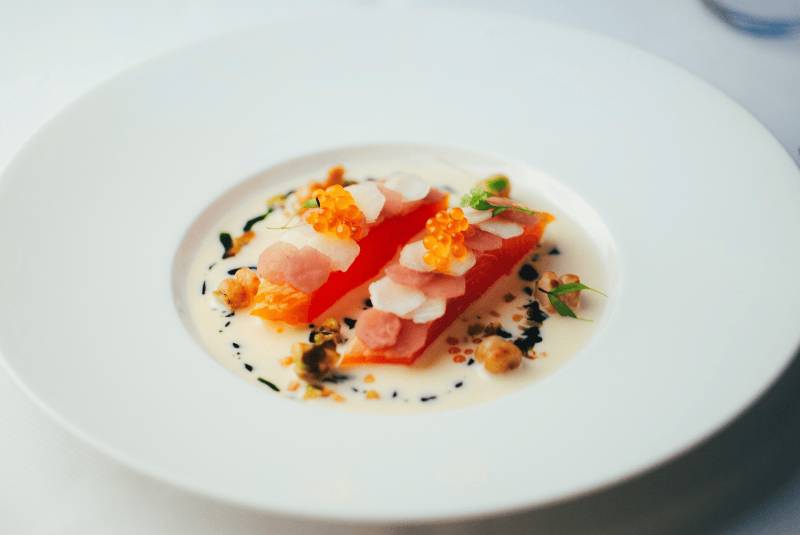
Locally sourced ingredients have always been the focal point of the menu at Toque!
Rooted in a firm sense of place, Laprise's approach of sourcing local, seasonal and sustainable ingredients eventually became the foundation of modern Quebec gastronomy. "This has always been Cuisine Quebecois because I'm Quebecois," he says. "My team is from here. My ingredients are from here. [But] back in the 90s, people thought Quebec cuisine was just beans and bacon."
"I've always stayed true to my vision. I don't chase trends"
Asked to define his cooking, Laprise pauses, saying: "Call it Canadian or Quebecois, I just cook what I love. What matters to me is the philosophy behind my cooking, rather than trying to tell a story with a dish. The freshness of the ingredients, traceability, sustainability, a connection to producers and a combination of flavours that maintains their individuality. I grew up on a farm and still get energy from the passion of small producers and the pride they take in their work. I love meeting other chefs, learning their techniques, but I've always stayed true to my vision. I don't chase trends, but I stay curious."
Laprise's seasonal menus at Toqué! reflect Quebec's ecosystems and are influenced by the cultures that coexist – Indigenous, immigrant and Quebecois – in the province. Eating local means that certain ingredients reappear annually. Think dandelion shoots in April, snow crab and asparagus in May or morels in June, but never with the same recipe.
He chuckles, recalling a couple who always dined at the restaurant in May for their anniversary. "One year, the wife asked why the menu never changed. I said: 'You always come in May! Of course it's crab, asparagus and morels. Change your annual date. Come in August, October or February. We follow the seasons.'"
Produce grown in Quebec such as boreal herbs and native berries have long inspired Laprise
That ethos extended to Brasserie T!, which he opened in 2010 as a casual sibling to Toqué!. Before shuttering in 2024, it helped support small farms through whole-animal butchery. "A small producer isn't selling 25 racks of lamb. You're buying two or three whole lambs. That's a lot of meat for a restaurant with 80 seats. Brasserie T! gave us the volume to use everything. So, when you eat lamb there, it's the same lamb from the same farm as Toqué!."
While the food served is central to the restaurant, hospitality is just as important: "The word 'restaurateur' comes from 'restaurer' ('to restore' in French). That's how I see our role. I want guests to feel comfortable the moment they sit down. In Quebec, you can be fine dining and still have fun. The service is warm and welcoming. It doesn't have to be pretentious," says Laprise.
"A restaurant has to reflect who you are"
Known widely as a supportive mentor, Laprise's influence extends far beyond his own kitchen. Some of Canada's most celebrated chefs, recently recognised on the North America's 50 Best Restaurants 2025 list, have all passed through his brigade including Cheryl Johnson and Charles-Antoine Crête (Montréal Plaza, No.22), Jessica Noël (Mon Lapin, No.2) and Steven Molnar (Quetzal, No.11). Stateside, Riad Nasr (Frenchette and Le Veau d'Or, No.10) and Corey Lee (Benu, No.13) have also spent time under his wing.
Laprise credits the chefs he apprenticed with in France for instilling the discipline that shaped his approach. "They taught me to be consistent and work very hard."
This rigour carries through to the way Laprise runs his kitchen. "A chef has to delegate. A chef who's screaming is usually trying to control everything, which isn't possible. When I consulted in New York, I learned how important it is to have a strong chef de cuisine. That experience gave me confidence in my cooking."
At the North America's 50 Best Restaurants awards ceremony, Laprise delivered words of wisdom to a rapt audience
He encourages young chefs to find their own voices. "When it's time to open a restaurant, besides talent, they must be ready to be entrepreneurs. The restaurant has to reflect who you are. Like Martin Picard who worked with me for five years, then opened Sugar Shack. He didn't copy Toqué!. That's what it's about."
"When I was in Las Vegas [at North America's 50 Best Restaurants 2025], I realised how lucky I've been," Laprise continues. "So many of the best chefs in North America have worked with me. We worked so hard and intensely together. You don't forget them. It's like family."
And when he eventually steps away? "I want to say: 'This is what I built,' and see it continue. I've spent my life bringing food to this level. It shouldn't disappear with me when I retire. I hope someone keeps pushing Toqué! forward."
"Transmission of knowledge is vital to the evolution of our gastronomy"
Laprise's impact stretches beyond the plate. He helped found La Table Ronde, a non-profit that unites independent Quebec restaurants and culinary entrepreneurs to advocate for the industry and share resources following the pandemic.
He also supports the Renaud Cyr Award, which honours chefs and artisans who promote Quebec's terroir, and lends his time to cultural institutions including Les Violons du Roy and Place des Arts.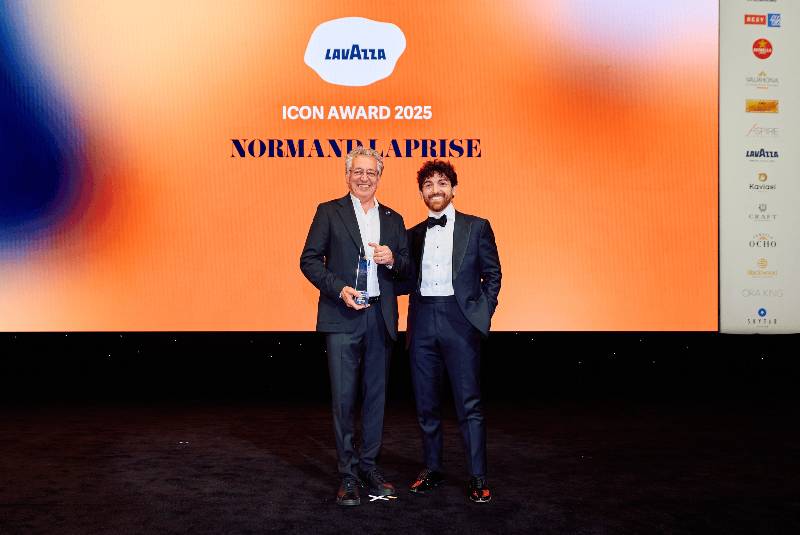
Laprise has collected a long list of accolades during his career, culminating in winning the Icon Award, sponsored by Lavazza, in Las Vegas last month
The cause closest to his heart is the Foundation for Autosomal Recessive Spastic Ataxia of Charlevoix-Saguenay (ARSACS), a rare and debilitating hereditary neurological disorder found in parts of Quebec. Each November, Laprise helps raise more than a million Canadian dollars for ARSACS research through fundraising dinners at Toqué!, bringing in a who's who of global culinary talent from Daniel Boulud to Pierre Gagnaire, Anne-Sophie Pic, Andoni Luis Aduriz, Corey Lee, Massimo Bottura, Éric Ripert and Emmanuel Renaut.
Despite a long list of accolades, including being named a Knight of the National Order of Quebec, Member of the Order of Canada, Relais & Châteaux Grand Chef and having a James Beard Award, Laprise remains humble. For Laprise, legacy isn't about recipes. It's about community, respect for the land and the relationships built along the way.
"The transmission of knowledge is vital to the evolution of our gastronomy," he says. "If we stand out internationally today, it's thanks to pioneering chefs in Quebec, notably Renaud Cyr and Jacques Le Pluart. As chefs, we all have a role to play in keeping our cuisine at the forefront. That means taking risks, stepping outside our comfort zones and reaching out to the next generation of chefs. It is together that we define the cuisine of tomorrow. And I think it will be modern, authentic and bold.
"I'm very proud to see Quebec restaurants on the North America's 50 Best Restaurants ranking. To realise, when you sit down to process this all, that: 'Wow, this has happened.'
Disover the full list of North America's 50 Best Restaurants 2025, sponsored by S.Pellegrino & Acqua Panna.