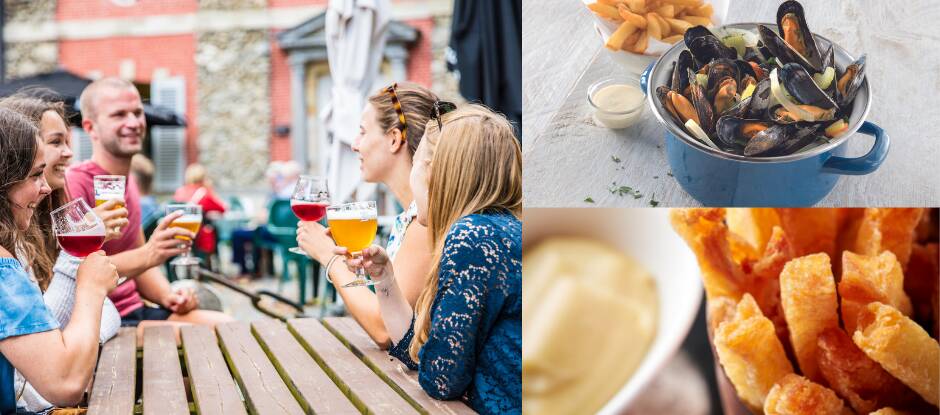
The high-fliers of the gastronomic world will descend on Antwerp, Flanders for the unveiling of The World’s 50 Best Restaurants 2021 on 5th October. Although there is no doubt the region is home to a host of excellent fine dining restaurants, the chefs and bastions of epicureanism will be seeking out a humble but no less delicious local delicacy: the world-renowned Belgian frieten
Consider the last restaurant menu you saw, but imagine it without potatoes. Now, ponder the dishes on rotation in your family kitchen and think about how they would work sans pommes de terre. Finally, consider a world without fries. Ok, don’t. Simply doesn’t bear thinking about, does it?
If the humble potato is the alma mater to some of the most-loved restaurant dishes in the world, then the fry is its coquettish cousin. When executed well, a promiscuously crisp and sultry veneer reveals a pillowy inner that yields to the faintest bite with heat, salinity and earthy notes indicative of the potato’s terroir. Indeed, a well-timed portion of fries – after a few cold beers or glasses of wine, perhaps – is on occasion as close to a spiritual experience as eating can become.
Such is the global passion for potato batons kissed with scalding fat, many countries have adopted fries to their nation’s kitchen. In Canada, the national dish poutine sees fries employed as a base for oozing cheese curds and thick gravy. In the UK, they make up an integral 50% of the emblematic fish and chips double-act; in France they make a traditional bedfellow for steak, chicken and myriad grilled meats.
In the US, fries are as ubiquitous as the fast-food joints that sell them. Indeed, the average American eats 30lbs (13.5kg) of fries each year. That’s roughly 77 servings from McDonald’s per person per annum, or an average of four portions a week.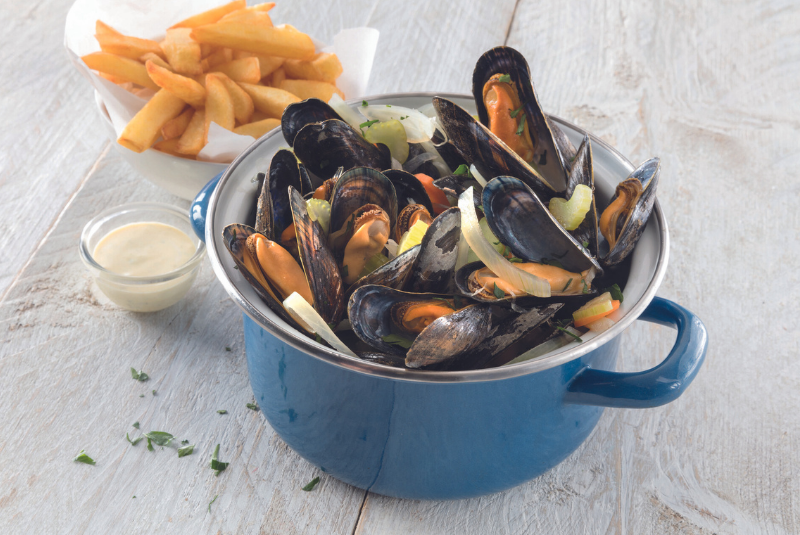
Frieten served with mussels (image courtesy of VisitFlanders)
There is one country, however, which eats more fries per capita than the US. In Belgium, residents consume up to one third more than their American counterparts each year, with 60% crunching more than four servings a week. They are also the only nation to hold the fry up as a national dish, without accoutrement. To Belgians, frieten call for no window dressing. They are always cooked in beef tallow (woe betide the vendor who uses oil), made from floury Flanders-native bintje potatoes, served in a paper cone and occasionally adorned with mayonnaise-based sauce. Ask any Belgian and they will be able to point you in the direction of your nearest hit. To know a favourite vendor by name is a point of pride and will often result in extra helpings.
Frieten are available from frietkots, ramshackle roadside stalls scattered across cities up and down the country. These frietkots number more than 5,000 nationally which, when extrapolated per capita, makes them 10 times more common than McDonald’s in the US. (The Golden-Arch yardstick is a fine fast-food barometer if ever there was one, but one we will stop applying from this point forth.)
Wars have been fought over less
With popularity comes dispute. Just like the debate surrounding Jesus’s birthplace and the location of the Lost City of Atlantis, two countries believe that the fry found its genesis within their borders. Neighbours Belgium and France have long competed over the fry’s origin story and, although there can be no finite proof, the Belgians have a stronger case.
The earliest claimed record of deep-fried potatoes comes from 1680 in what was then the Spanish Netherlands. A manuscript from the Meuse Valley suggests: “The inhabitants of Namur, Andenne and Dinant had the custom of fishing in the Meuse for small fish and frying them,” it reads. “But when the river was frozen and fishing became hazardous, they cut potatoes in the form of small fish and put them in a fryer.”
It’s a plausible story and one not dissimilar to the current day – potatoes shaped like fish seem straight from the convenience-store playbook of spaghetti-formed letters, dinosaurs made from non-specific meat and potato reconstituted into a plethora of shapes to appeal to small mouths. The people of the Meuse were onto something.
Although if fries are from Belgium, it begs the question as to why much of the world refers to them as ‘French fries’. A patriotic Belgian would be quick to tell you that the word ‘friet’ comes from ‘patates frites’, the Belgian-French for ‘fried potatoes’. However French food historian Pierre Leclercq argues differently: “Even if the Belgians don’t like it, the fries of today are fundamentally Parisian and were first served as a snack from the Pont Neuf bridge in the 18th century,” he said in an interview with national newspaper Le Monde, to add further fuel to the fat fryer.
The Belgians have a riposte. Many American soldiers were stationed in French-speaking Belgium when defending Europe’s Western front during World War One. Local cooks had already become au fait with sating the UK army’s penchant for ‘chips’, as the Brits call them. When US soldiers came and found them equally agreeable, they returned home telling tales of wonderous golden-fried potatoes, having believed they were in France (French was the official language of the Belgian forces, hence the confusion).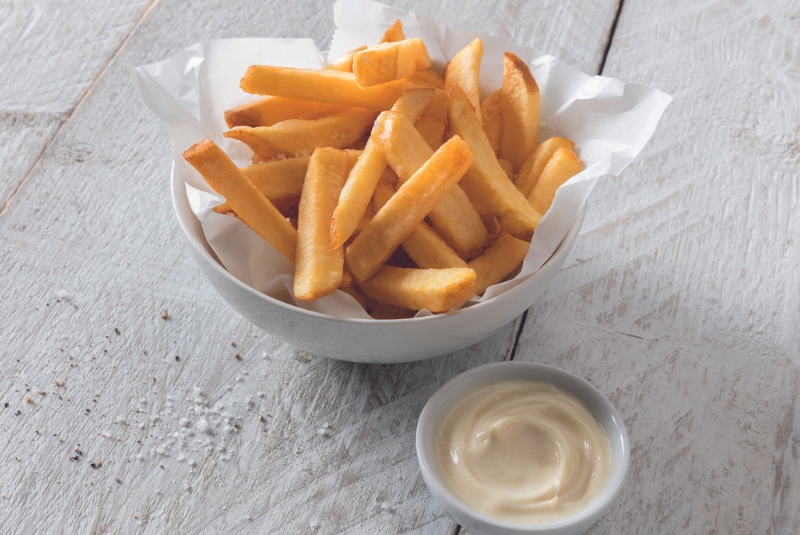
A serving of Belgian frieten (image courtesy of VisitFlanders)
Improving on perfection
Wherever they originated, there is no escaping the fry’s reach across the world. Arguably the method to prepare them most effectively (another contentious issue, of course) only arrived during the mid-1990s. Chef Heston Blumenthal, whose The Fat Duck is part of the elite Best of the Best group of establishments that have placed No.1 in The World’s 50 Best Restaurants lists, took it upon himself to scientifically deconstruct the fry’s constituent parts in search of the Holy Grail of cooking technique.
“My friends and I were sitting in a pub in London, discussing how disappointing it is to receive soggy chips [fries],” says Blumenthal. “Immediately I felt the need to go home and work out how to guarantee that a chip would not become soggy.
“I put together a number of experiments where I limited the variables and quickly found out that it was the moisture evaporating from the inside of the chip that was causing the crust to go soggy. Once I’d established that, the rest was pretty easy – you just have to be sure to remove the moisture before they go into the deep-fat fryer.”
And with that, the legend of Blumenthal’s triple-cooked chips was born. Whether it’s been adopted by the centuries-old frietkot vendors, you will have to travel to Belgium to see.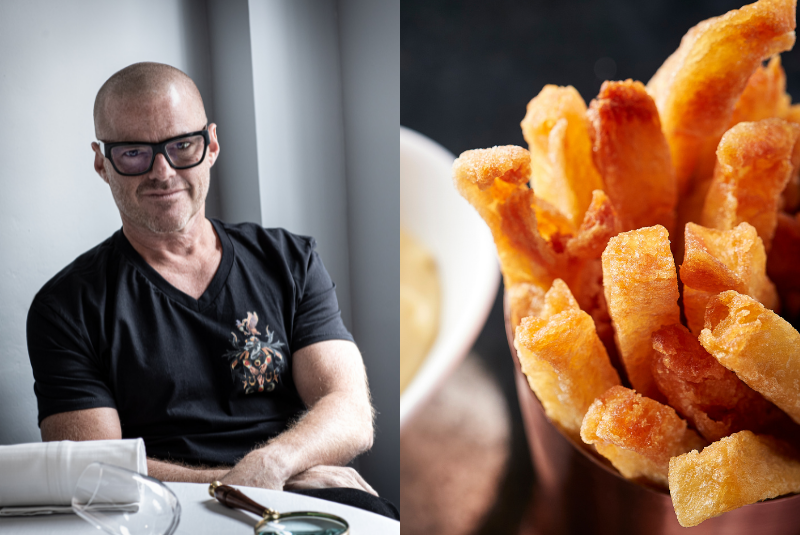
Chef Heston Blumenthal and his triple-cooked chips (image courtesy of John Scott Blackwell)
A certified institution
Five years after Belgian beer was granted UNESCO cultural heritage status, the country looked to the United Nations to see if they would extend the same courtesy to the region’s fries. After some debate, fries were named an integral part of Belgian national culture. “The Belgian fry is saved! Europe has listened to Belgium,” said Belgian agriculture minister Willy Borsus in a triumphant 2017 statement.
There are interesting parallels that can be drawn between Belgium’s love of fries with the locals’ irreverence and lack of conformity. Bernard Lefevre, the representative of UNAFRI, the national association of frietkot owners, said: “The culture of fries is rooted in all of us and because of that we need to protect it. A cone of potato chips is Belgium in miniature… The unpolished establishments are uniquely Belgian, combining the country’s embrace of chaos with a dislike of corporate uniformity.” Essentially, it doesn’t matter where the fries come from, simply that they taste good – a philosophy most can get on board with.
As the pandemic gripped Europe in the summer of 2020, many governments reported food shortages from producers and on supermarket shelves. But as food vendors were forced to limit service, it prompted a surplus glut of potatoes destined for frietkots in the Belgian supply chain.
The potato producers called and their administration answered. Romain Cools, secretary general of Belgian-state backed group Belgapom, issued a cry for help to the country’s citizens: “Eat fries. Twice a week. At least,” he implored.
As government advice goes, there have been less-popular national diktats. To further misquote a rival 18th Century French queen: “Let them eat fries!”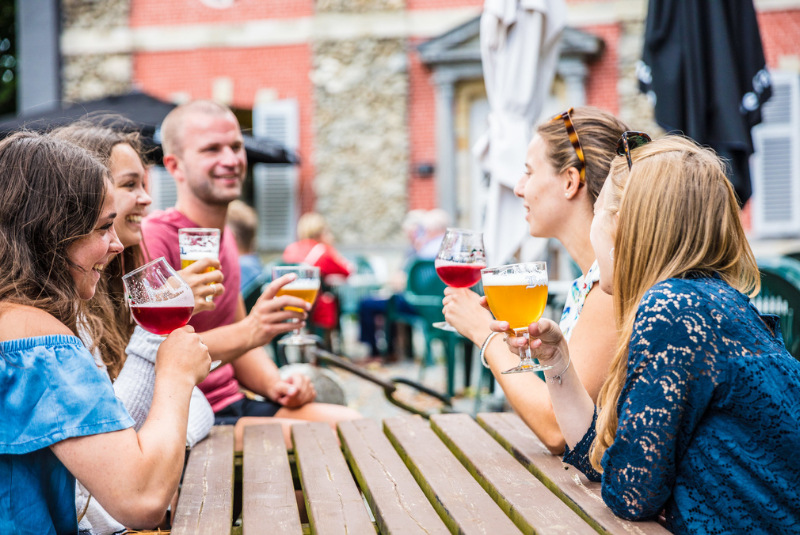
(image courtesy of VisitFlanders)
The World’s 50 Best Restaurants is coming back in 2021, with an awards ceremony and hybrid event programme to be hosted in Antwerp, Flanders, in October. To be the first to hear about the latest news and announcements, join the community on Instagram, Facebook, Twitter and YouTube.