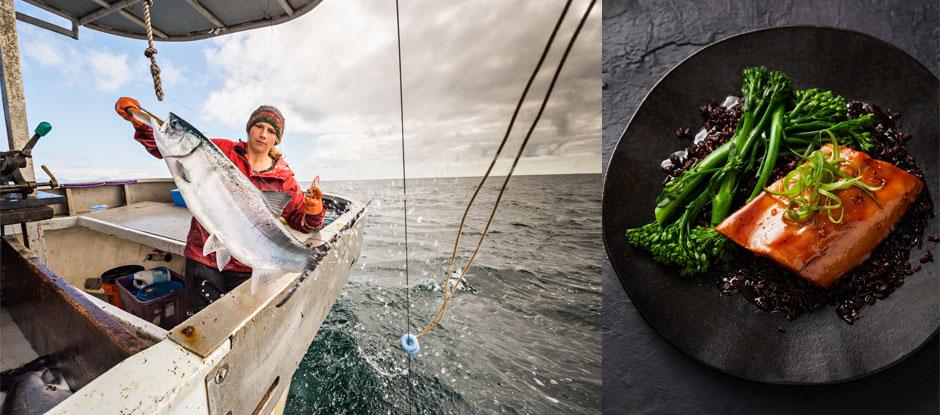
Presented in partnership with Alaska Seafood Marketing Institute
One of the greatest journeys in nature’s ecosystem is undertaken by the pristine wild Alaska salmon, so epic is its path from spawn to sea and back again. Food writer Clarissa Hyman explores the species, shows how to eat it at its best and suggests a recipe that will work in your kitchen at home
Wild Alaska salmon is a fish that conjures images of shimmering beauty and glorious thick-cut fillets. While its name may not trip off the tongue, a degree of specificity is essential in ingredient selection to ensure that you are working with the best. If you want to further impress, baffle or simply irritate your fishmonger then you could ask for some nice fillets of ’Oncorhynchus tshawytscha’, assuming you can pronounce the tongue-twisting classification for the mighty king salmon. Also known as Chinook, it is the largest of the Alaska salmon species and it is rich in the oil, proteins and omega-3 fatty acids that provide such a full, firm and complex flavour.
The king is the catch that salmon fishermen dream about, plucking the muscular fish from the icy, crystalline Alaska waters. The first catch is keenly anticipated by fishermen, chefs and home cooks alike in a region where salmon is revered for its awesome power and place in the natural world.
How to make a seacuterie board with Alaska smoked salmon:
Southeast Alaska is one of the great breeding grounds for all species of Alaska salmon. The numerous islands, steep mountain ranges and 150 inches of rainfall a year combine to create thousands of streams and rivers. One of the first traders to reach the region reported that during the spawning season salmon packed the rivers from bank to bank so densely one could walk across on their backs.
This abundance is seasonal and many Alaskans can predict the week, the day, the tide, almost the minute ‘their salmon’ return. Over time, the indigenous population developed not just a variety of catch methods from spears and nets to complex weirs, but hundreds of drying, fermenting, and smoking preservation techniques.
Originally, smoking was a necessity to preserve the fish over the winter months; today it is part of daily culinary culture. One popular method is hot-smoking, sometimes called ‘kippering’, in which the filleted salmon is wet- or dry-brined, usually with salt alone, although more esoterically with sugar, juniper berries or garlic. The fish is then rinsed and air-dried before being hung over a smouldering wood fire. ‘Planking’ involves lashing the fish to driftwood. Both methods produce succulent and moist flesh with a rich, smoky flavour. Numerous variations include half-drying, which forms part of an indigenous dish from the Aluutiq people that culinary historian Ann Chandonnet references as a preparation where a half-dried salmon is simmered with wild onions before it is ready to store.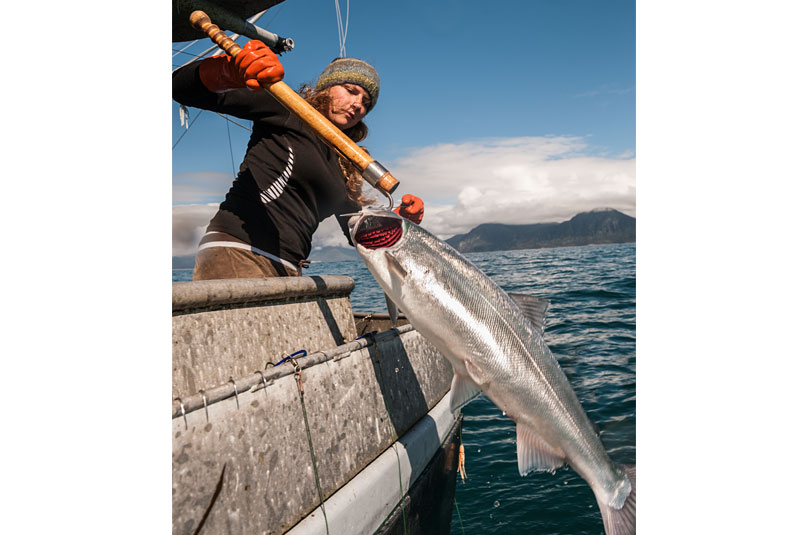
Fresh salmon caught in the Alaska waters
One startling sight, according to Chandonnet, is a line of salmon tails sticking out of the dirt until the tails come off in the hand. This means the fish have ripened into a curious dish known as ‘stink fish’, eaten raw. As she says, “The line of tails is the fast-food version of the dish.” The more time-consuming version, meant to be harvested months later, is a pit lined with wild celery leaves and filled with salmon or salmon heads. A challenge indeed for extreme eaters.
Of course, while these traditional techniques are still in play, modern chefs find myriad ways to further enhance the natural flavour of Alaska salmon. The well-structured flesh responds well to slow, temperature-controlled cooking in a water bath, just as it does to being steamed en papillote with fragrant herbs.
It marries with a wide range of flavours but Asian ones stand out: coriander; soy; sesame; chili; lime. An example is the exquisitely refined East meets West gravlax (a cold smoked salmon) with Asian herbs on the menu at Raw in Taipei – currently ranked No.21 in Asia’s 50 Best Restaurants – which is run by André Chiang and Alain Huang. In another geographical direction, Canadian TV chef David Wolfman is both classically trained and of First Nations heritage: he shows his respect for the sacred fish with indigenous fusion dishes such as Xaxli’p salmon baked with dried seaweed and stuffed with dandelion and pepper.
A voyage worthy of fiction
Wild Alaska salmon is a fish that demands respect: it has an extraordinary life cycle; a natural history that could be torn from the pages of Tolkien. They are anadromous in that they hatch in fresh water, migrate through rivers, falls and rapids to the ocean where they mature and fatten for several years. When the time comes to reproduce they return to fresh water, typically leaping over the natural obstructions in their way: not only that, but they instinctively go to the same river of their birth and even to the exact spot where they were hatched.
How to make a bagel with cold-smoked Alaska salmon:
The salmon travel phenomenal distances upstream against a strong current to reach their spawning grounds and lay their eggs. Their work done, destiny achieved, the exhausted fish meet their final resting place. In due course, the newly hatched salmon repeat the adventure.
There are still many unanswered questions about the mysterious forces that propel salmon to make such amazing journeys: they are thought able to judge the right time to return from the sea by gauging the change in daylight hours, and the homing instinct may depend on their powerful sense of smell. Little is known about their behaviour patterns when at sea, but Alaska fisheries are committed to understanding more and sustainably maintaining every element of the fishes’ lifecycle.
Sustainable seafood was woven into the Alaska state constitution more than 60 years ago and is the foundation of the primary federal fisheries law, informing the Magnuson Stevens Act, the legislation providing for the management of marine fisheries in Alaska. Today, fisheries managers of the state, federal and international management programmes have a shared goal of sustainability. Each management programmme is committed to achieving optimum yield, or the harvest level that will provide the greatest overall ecological, economic and social benefits, while also preventing overfishing and harm to ecosystems and fishing communities. Most Alaska fisheries hold the most comprehensive third-party sustainable seafood certifications that a wild fishery can receive – Alaska RFM (Responsible Fisheries Management) and MSC (Marine Stewardship Council) accreditation.
The great food writer Waverley Root noted there is a mysterious law of nature which decrees that foods develop taste to their full potential only when they have had to struggle to survive against the perils of their environment. Salmon could be compared to endurance athletes: too soft a life is not good for them; their spirit is built through tribulation. So forget the flab: choose a lean, mean natural fish for a fillet whose ancestors have battled against the stream to arrive in the best possible condition for your gold medal-worthy plate.
TRY THIS RECIPE AT HOME
Alaska Salmon Char Siu with Broccolini and Crispy Rice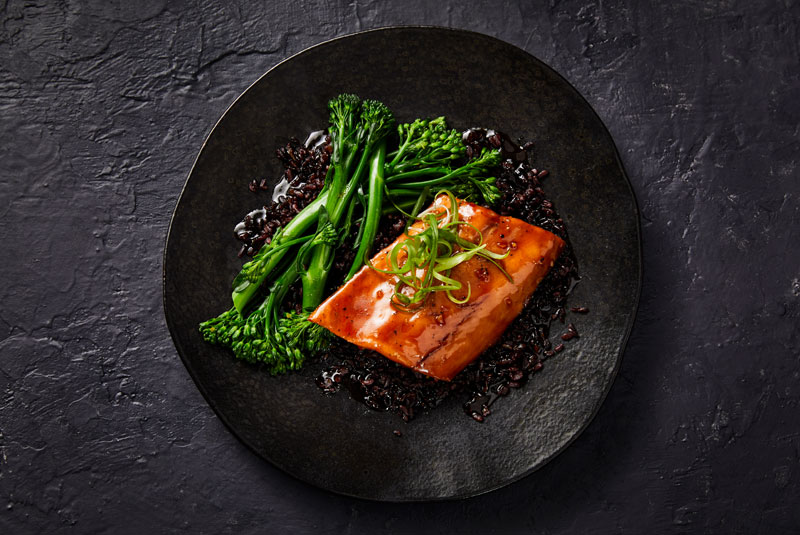
SERVES 4
80ml hoisin sauce
80ml soy sauce
30g brown sugar
2 tbsp shaoxing rice wine or sherry wine
2 tbsp honey
1 tbsp garlic, minced
½ tsp five spice powder
¼ tsp white pepper, ground
1 tsp molasses
1 tsp toasted sesame oil
4 Alaska pink salmon fillets, pin bones and skin removed
4 cup glutinous black rice, cooked
4 tbsp butter, unsalted
Pinch of salt and pepper
2 bunches broccolini
2 green onions, washed, thinly sliced
For the char siu marinade
To make the marinade, add the hoisin, soy, brown sugar, rice wine, honey, garlic, five spice, white pepper, molasses and sesame oil to a small mixing bowl and whisk to combine. Pour ½ cup of the marinade over the 4 pieces of salmon and move the salmon pieces around in the marinade to ensure they are thoroughly coated. Cover and place in the refrigerator for 1 hour. Reserve remaining marinade.
Cooking the salmon
Line a sheet pan with foil, then parchment paper, then place a roasting rack on top. Transfer the salmon pieces onto the rack, scrape all the marinade from the bowl and drizzle over the salmon. Bake the salmon in a preheated oven set to 400F/200C for about 5-10 minutes, depending on the thickness of the salmon. Cook until just opaque throughout. Keep warm.
For the char siu sauce
Place the reserved marinade in a small pot with ¼ cup of chicken stock or water. Bring just to a simmer, then turn off the heat and stir in 2 tbsp butter. Keep warm.
For the rice and broccolini
Pre-heat a large frying pan over medium-high heat, add 4 tbsp butter and the cooked black rice. Toss the rice, then flatten out and allow to cook 2-3 minutes or until the rice starts to crisp up on the underside. Season the rice with salt and freshly ground black pepper. Toss the rice to flip and repeat crisping up the second side. Once the rice is thoroughly heated and somewhat crispy, divide among 4 warm plates.
Cook the broccolini in salted boiling water for 1 ½ - 2 minutes or until al dente. Strain. Divide among the 4 plates, arranging a couple broccolini branches on each plate on top of the black rice, skewed to one side.
To serve
Transfer one piece of cooked salmon to each plate, placing on the black rice, next to the broccolini. Drizzle a bit of the warmed char siu sauce over the salmon, the rice, and around the plate. Garnish the salmon with sliced green onions.
Follow 50 Best on Instagram, Facebook, Twitter and YouTube for the latest news, features and initiatives in support of the global restaurant industry.