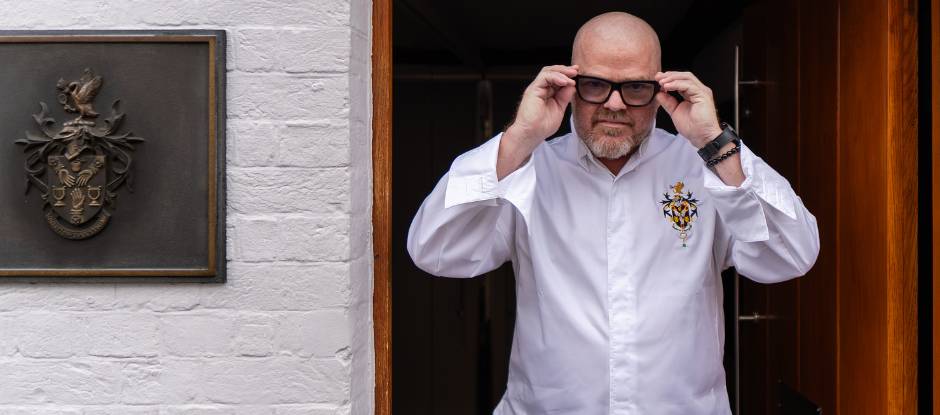
The legendary chef of The Fat Duck discusses his bipolar diagnosis, restless perfectionism and why he launched a menu for people on weight-loss medication.
Heston Blumenthal, even the name sounds whimsical and fantastical. The Fat Duck could surely only have ever ended up as a playground of culinary creativity and innovation. But in the early days, the plan was somewhat simpler. "After I had a multi-sensory moment at L'Oustau de Baumanière, I said to myself, 'what do I want to do? I want to cook'."
From an ugly duckling to The Fat Duck
Blumenthal grew up in London and moved to the countryside aged 10. "My mum was a good cook, but my parents never really went to restaurants – they'd never been to a Michelin-starred restaurant, that was for sure."
At the time, food in Britain wasn't particularly renowned. "French president Jacques Chirac said Britain has the worst food in Europe, second only to Finland. It was two weeks before the Olympic Games were decided. After that, two Finnish representatives withdrew their votes from Paris and voted for London. So we could argue that we got the Olympics because of our food – as bad as it might have been!" Blumenthal says.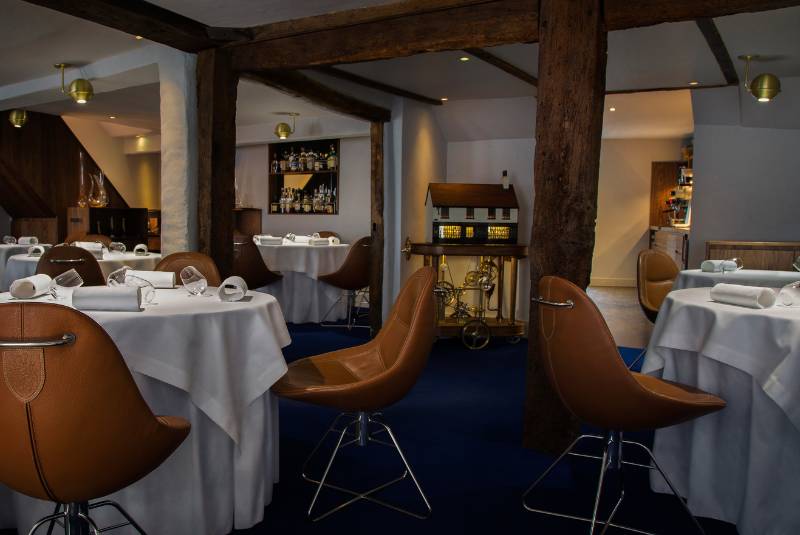
The Fat Duck opened in the small village of Bray, just outside London, in 1995
Aged 16, Blumenthal had a transformative experience. "My parents took us to France. My dad had read about this restaurant called L'Oustau de Baumanière. And it had three Michelin stars. I went there and it was like I'd fallen down a multi-sensory rabbit hole," he says. "I remember the noise of the feet of the waiting staff crunching on the gravel. There was the smell of lavender in the air. It was loud, with the noise of crickets everywhere. And then the clink of the glasses. Just the whole thing."
From that moment, he bought French cookbooks and translated them using an English-French dictionary. "Then Harold McGee's book On Food and Cooking: The Science and Lore of the Kitchen came out. I started researching cooking and the science of cooking, almost at the same time."
Various jobs, from being a photocopier salesman to a bookkeeper, kept him afloat, but he'd wanted to cook since that memorable moment in the Baumanière. Not motivated by anything else, he eventually found a place. "I borrowed about £10,000 from my dad, sold a house, moved in with my parents and used that money. So my first paid job as a chef was opening The Duck.
"While doing the refurbishment, an old lady walked past and said, 'oh, what are you doing here?' I said, 'I'm opening a casual restaurant where you can have half a dozen oysters and a glass of white wine or a pint and a pastry'. I thought, this is great. I'm making friends with the locals now.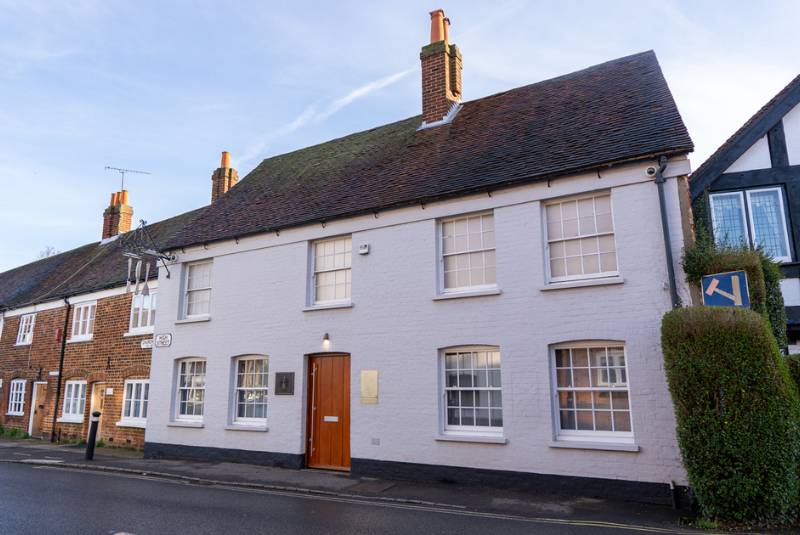
Blumenthal originally planned to make The Fat Duck a casual pub-restaurant
"She looked at me and said, 'we've had three owners in five years. We've closed them down – and we're going to close you down too!' And she shook her stick at me. So that's when I opened, with myself and a pot washer and two people front of house. I had no idea how hard it was going to be. Not at all."
Restless perfectionism
Being a self-taught chef is a double-edged sword. "While I wasn't bound by constraints and fine dining, the downside was my organisational ability and skill. I knew nothing about running a kitchen," he says. That meant working even harder. "For the first 10 years, I was sleeping for 20 hours a week."
However, it didn't take him 10 years to get organised. Eventually, the lack of sleep was down to his creativity, relentlessly experimenting and trying to perfect dishes like Bacon-and-Egg Ice Cream, Sound of the Sea and Hot and Iced Tea – and as he later admits during the conversation, likely a symptom of his ADHD.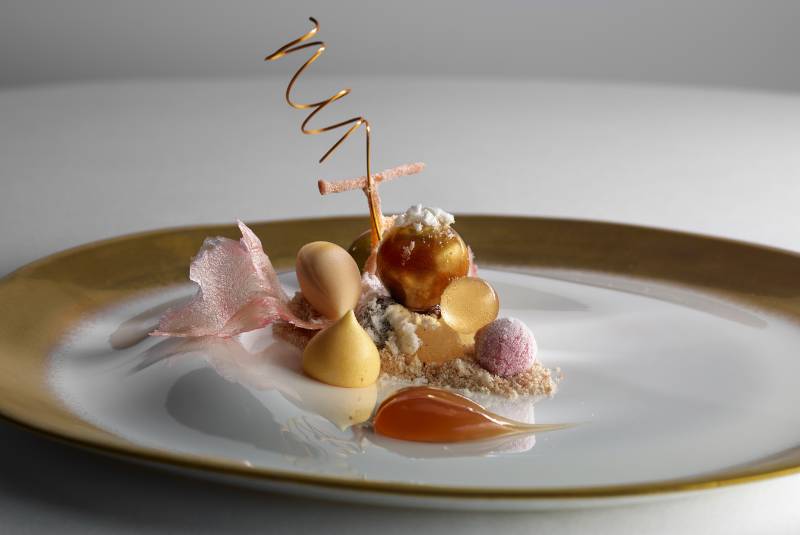
An example of Blumenthal's 'restless perfectionism', Botrytis Cinerea is made up of 20 different elements and more than 50 stages of preparation
The experimentation Blumenthal is known for is next-level: a new dish for The Fat Duck takes an average of three-to-four years to go from conception to reality. "When dishes go on the menu, it's like putting a train on its tracks. It meanders through the valleys and up and down the hills. But the train will be painted, redecorated and painted again. That's what we do in The Fat Duck. When a dish goes on the menu, of course it's good enough to be there. But a few months later, I want to tweak it. I call it restless perfectionism."
A world of pure imagination
Widely regarded as a real-life Willy Wonka, Blumenthal still searches for those Eureka moments, even today. "It's the best when the lightbulb comes on and something connects," he says.
And he couldn't imagine a world without imagination. "It's the 'human doing human being'," he says. "The doing is all the linear stuff – take 200g of sugar and butter, mix it together for 15 minutes, put it in the oven – all of that is the doing. The being is the emotional connection with the doing."
While often featured in the same sentence as Blumenthal and The Fat Duck, he has always had a problem with the phrase 'molecular gastronomy'. "I've come up with the term 'multi-sensory gastronomy'," he says. "I realise what I really wanted to do was replicate that memory of the moment in that restaurant. But in Bray, there's no bauxite cliff, there's no Provencal valley, there's no gravel crunching or water fountain – it's just a little ex-pub on the side of the road. So I brought in the other elements."
An experience at The Fat Duck certainly is multi-sensory and whimsical, with tableside preparation, liquid nitrogen, lighting changes, sounds of the seaside, a mechanical sweetshop, lullabies and floating pillows all forming part of a guest's visit to Heston Land.
Dishes like Counting Sheep demonstrate Blumenthal's whimsical side
"Everyone has a relationship with food, and no-one's relationship is the same. That relationship also changes over time," he says. "There's a fantastic quote from a Greek guy called Heraclitus: 'A man cannot step into the same river twice, because it is not the same river, and he is not same man'. That's how I feel about food, and about dining at The Fat Duck – you'll never have the same experience twice."
Heston: My Life With Bipolar
From In Search of Perfection to Heston's Feasts, Blumenthal has been on TV screens since the early 2000s. "The TV shows were brilliant for learning, for research, for development, but the tricky thing was making all the big things delicious. But they all brought people together. And when you see a giant chocolate bar and people had access to it, you could watch adults becoming kids again. I really love that feeling."
In 2025, Blumenthal released a very different kind of show. The documentary, Heston: My Life With Bipolar, is a difficult watch. In it, Blumenthal talks about being sectioned in 2023, and how hard the experience has been for his family.
"I have or I am bipolar. So that's a fact. I have ADHD. That's a fact. I'm a man. That's a fact. All these things together, along with other things, make up the whole," Blumenthal says. 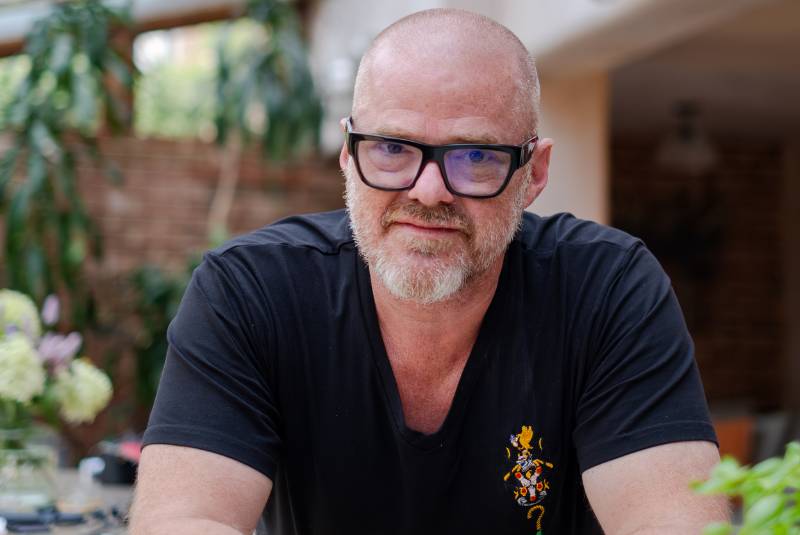
The documentary, Heston: My Life With Bipolar, came out in 2025
Building a restaurant like The Fat Duck was never going to be easy. Blumenthal believes working in the kitchen somehow contained his bipolar and that his ADHD sometimes helped with his 'relentless perfectionism'. "I think being in that little kitchen framed my bipolar and sort of kept it in. When I was on the manic highs, the not sleeping bit, it somehow worked. But when it came to the lows, it really didn't work.
"When I was told I might have ADHD, I said, 'well how come I've spent X number of years focusing on one subject?' The chap said to me, 'that's exactly what ADHD is'. Over the years I've tried to light a blow torch with hot water and left the dustpan and brush in the fridge."
The documentary achieved its aim in Blumenthal's eyes: to raise awareness (around 1.3 million people in the UK live with bipolar). "Since the TV show, awareness has gone up," he says. "I've had loads, tonnes, of wonderful messages from people saying thank you – and not just from people that have bipolar, but also the people that live with people with bipolar."
While Blumenthal acknowledges there is still a stigma around it, he and Melanie are now ambassadors for Bipolar UK, and are continuing their work to change perceptions.
The last dinner, back-to-front menus and Thin Duck
After more than 30 years in the industry, it is a challenge to keep things fresh. In March 2026, Blumenthal announced that Dinner by Heston Blumenthal, his two-Michelin-starred restaurant at The Mandarin Oriental in London, would close in January 2027. It opened in 2011, with Ashley Palmer-Watts (who now looks after food at The Devonshire) as the head chef.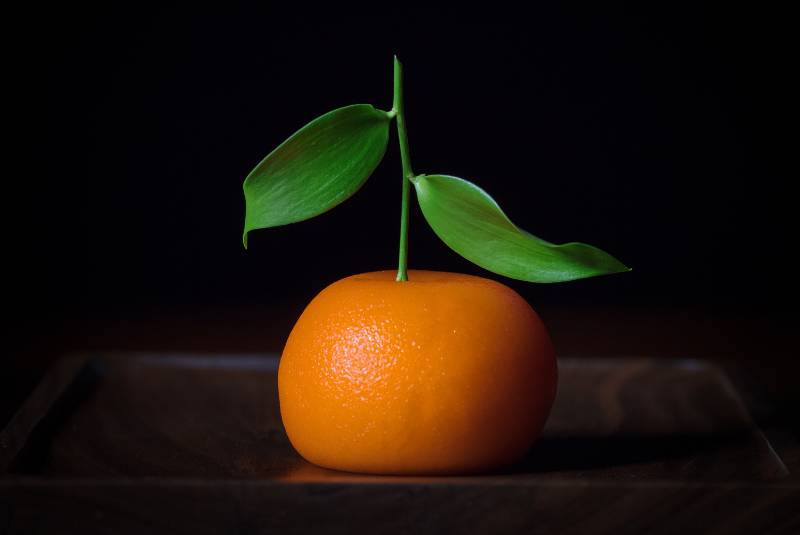
Meat Fruit is the most iconic dish at Dinner by Heston Blumenthal
As is the Blumenthal way, dishes including Meat Fruit (a chicken liver parfait in the shape of a mandarin) and the Tipsy Cake gained worldwide recognition. Blumenthal said the lease at the restaurant was due to run out in July 2026, but an extension agreement was reached so it could celebrate its 16th birthday before shuttering.
Restaurant closure aside, Blumenthal can't stop himself from continuing to flip the fine-dining world on its head – quite literally. "My motto is to question everything. A bit like an annoying school child. 'Why, why, why?'"
His Topsy Turvy menu (available on select Thursdays) is an example of this instinct. "After Tudor times, food was put on the table at the same time, with savoury and sweet together. Then it moved to courses, with desserts at the end," Blumenthal says. "I wondered why the sweet is always at the end of the meal, so it's then obvious to me to ask, 'what happens if it's at the beginning?'"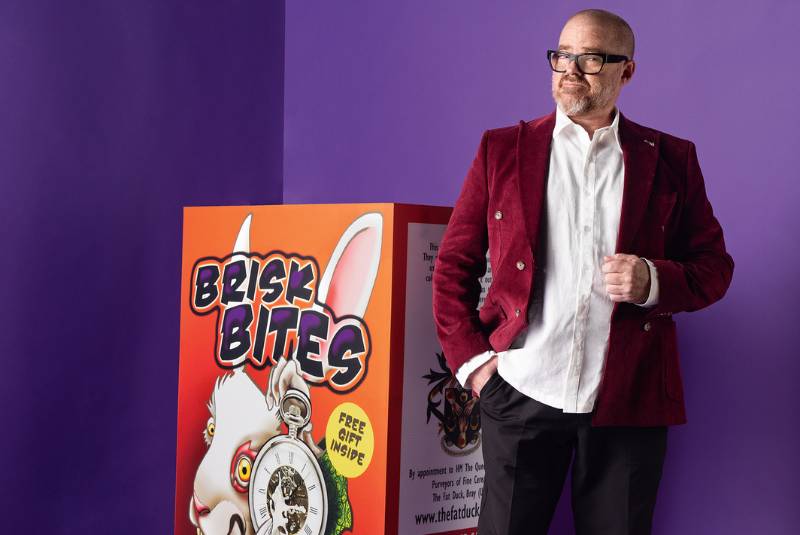
After more than 30 years, Blumenthal is still finding ways to innovate
There was also plenty of noise around the launch of the Mindful Experience in late 2025. It's hard to avoid the conversation around weight-loss drugs. Yet what might be seen as a problem for the fine-dining world, Blumenthal has added his spin to.
Guests at The Fat Duck can still enjoy the same dishes, but portion sizes are reduced by about 25 per cent per dish. "I've spoken about mindfulness for nearly 10 years, and was unknowingly doing it all along," Blumenthal says.
"After my bipolar diagnosis, I put on a lot of weight. The psychiatrist told me it was a side effect of the medication, but the most important thing was to get my bipolar stabilised. A good friend of mine suggested I looked at weight-loss injections... and I've now lost 20kg."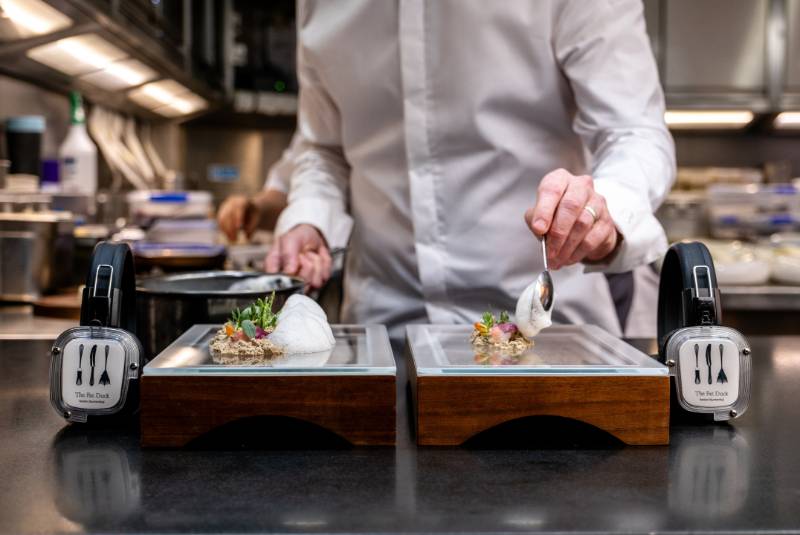
The Mindful Experience at The Fat Duck is the same menu, but with smaller portion sizes
While the millions of people taking weight-loss medication was of course a catalyst, Blumenthal says it wasn't the only consideration. "I am absolutely adamant that if we eat less food, it's the easiest way to save the planet. If you eat less food, there's less industrial agriculture. With less industrial agriculture, you're saving water. So from my bipolar diagnosis to weight-loss drugs to the impact on the food sector, the Mindful Experience is a way for people to still experience The Fat Duck."
It wouldn't be the first time Blumenthal had kick-started a trend – sous vide cooking, triple cooked chips, outlandish flavour combinations, redefining historic British food – there aren't many chefs with as many claims to culinary fame.
Blumenthal says: "It's taken me 30 years to get there, but I have got to the point where I can acknowledge what I and the restaurant have achieved. Before, I could never have done that. But this restaurant helped change the world of gastronomy."
The Fat Duck was named The World's Best Restaurant in 2005 and is part of the Best of the Best hall of fame.
Discover 13 of the most iconic dishes at The Fat Duck