From a forest-moss trompe-l'œil to a foundation that marries Kentish sole with seaweed, these chefs are redefining what the classic ingredient can do.
Our obsession with butter predates most food trends. In medieval Saxony, the royal family was so tired of oil-based fruitcakes that they petitioned the pope for permission to add butter, while legendary chef Paul Bocuse once quipped: "Without butter, without eggs, there is no reason to come to France." Today, chefs around the world are quietly achieving mastery with the spread, as both an anchor of the bread course and a foundation for pastries and proteins. Here are six restaurants where butter is far more than just an accompaniment.
The Sportsman, Whitstable
Butter with harvested Kentish salt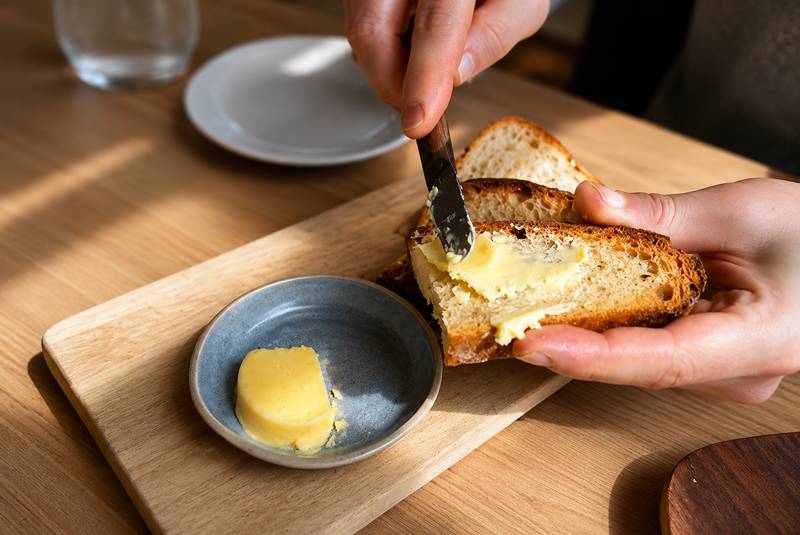
At The Sportsman, butter is served with soda bread made using the buttermilk byproduct of the churning process
Butter's place at the fine dining table was not always secure – but when early 2000s kitchens pivoted towards low-fat, "clean" food, chef-owner Stephen Harris of The Sportsman looked to the history of Kent and its history as a salt marsh to make his own version of the pricey French Échiré butter he loved.
Harris continued the Iron Age tradition of harvesting sea salt for which the pub's village, Seasalter, is named. After boiling down filtered seawater, the salt that remains is used to season The Sportsman's butter. That butter is equally rooted in place: churned from the Jersey cream of a single local herd, grazed on a single field, ensuring a consistency of character that runs from pasture to plate. "If you have beautiful Tuscan olive oil, you wouldn't dilute it," Harris claims. "Butter is the same." For him, cream and butter are as central to Kent's identity as olive oil is to hills of Chianti.
Butter's role here extends well beyond the bread course. The Sportsman's signature slip sole in seaweed butter was born from a trip to Japan, where Harris fell in love with its umami. "When I came back I thought, hang on, there can't just be good seaweed in Japan. We must have our own." Sure enough, Harris found sea lettuce and gutweed along the Kentish coast. After being dried and powdered, the seaweed is folded into butter, defining a signature take on sole – on the menu since 2008.
Narisawa, Tokyo
Moss butter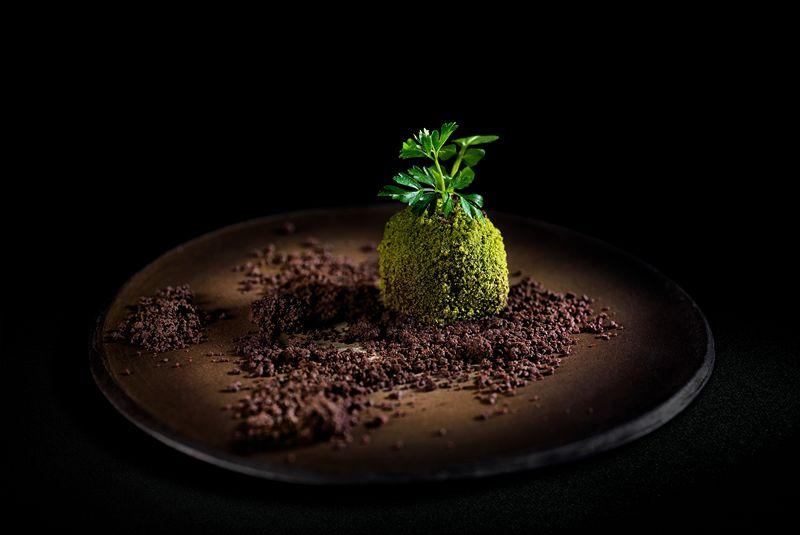
Narisawa's moss butter is served with bread baked in a stone oven before guests
In Tokyo, a city defined by density and speed, chef Yoshihiro Narisawa has built a restaurant that feels like you're stepping into a forest. Here, he draws on Japan's finest produce – including the invisible, often overlooked world of micro-organisms – to find beauty in nature that transcends culinary borders. Nowhere is this philosophy more fully expressed than in his signature pairing: Bread of the Forest with Moss Butter.
The butter begins with high-quality dairy from Hokkaido – clean and light, with a delicate richness – before it is coated in black olives (to represent soil), adding a gentle saltiness. Chlorophyll is used to render the moss, while wild herbs gathered from Japanese forests add to the garnish, allowing guests to experience the forest simultaneously through sight and taste. "With forests, rivers and moss forming the landscape of nature, 'moss' was created to evoke the atmosphere of the forest," chef-patron Narisawa explains.
The chef chooses butter over other spreads given its global appeal: "We serve Bread of the Forest with butter so that both international guests and guests from Japan can enjoy a flavour that feels familiar and comforting."
Rosetta, Mexico City
Chicatana ant butter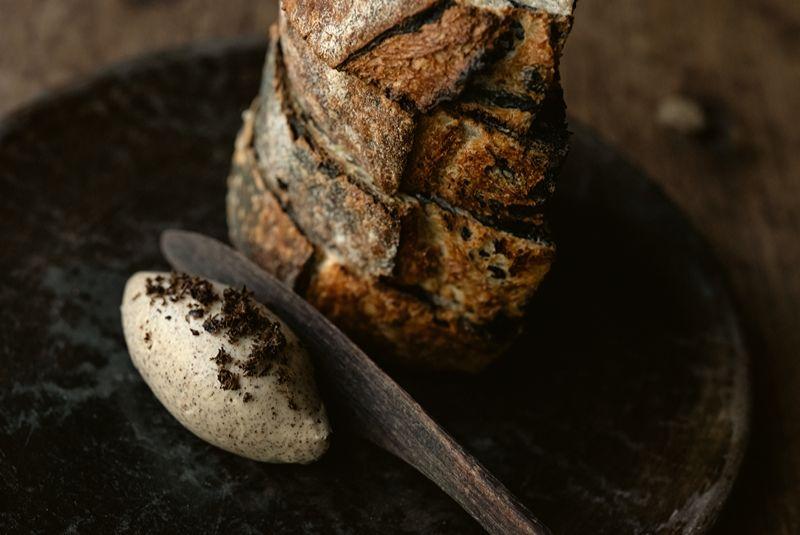
At Rosetta, butter is blended with seasonal chicatana ants, a delicacy harvested after the first rains in southern Mexico
Elena Reygadas did not grow up eating butter. Mexican home cooking belongs, historically, to lard and oil. The country's warm terrain is ill-suited to the water-intensive practice of cattle farming, resulting in cream that tends to be less rich. This context, she says, is precisely why at Rosetta they work with butter of a higher quality than what is commonly available, "we try to use it thoughtfully and with intention".
Her relationship with butter deepened while working in European kitchens, where pastry taught her to understand it as a resource, alongside its ability to carry aroma and create depth. When Reygadas returned to Mexico, she began to think of butter not as a foreign ingredient but as "a generous medium" for uniquely local ingredients.
"By incorporating something like chicatana ants, the butter becomes a vehicle for a distinctly Mexican flavour," Reygadas says. "The idea was to let Mexican ingredients transform the idea of butter." Reygadas translates the Oaxacan tradition of grinding ants to season salsa into butter-making. First, the ants are toasted and ground until they develop what she describes as an extraordinary aroma: "nutty, smoky, slightly earthy with a depth that is difficult to compare to anything else." Once it is blended into butter, the result is "surprisingly elegant", with a subtle bitterness and a roasted note that almost resembles cacao or coffee.
It is served with an equally intriguing corn and totomoxtle ash sourdough. For some guests, chicatana ant butter sounds unintuitive, even provocative. But it tastes, she insists, harmonious and natural.
Henne Kirkeby Kro, Henne Kirkeby
English crumpet with caviar and butter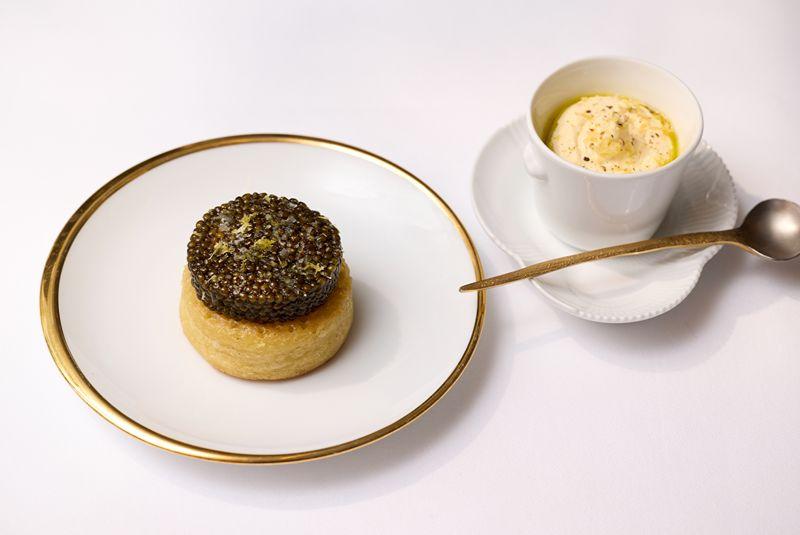
Served as a supplement to the tasting menu, the crumpet at Henne Kirkeby Kro comes with sturgeon caviar and crème fraîche
On Denmark's remote west coast, head chef Alan Bates offers a snack course that is provocative in its simplicity: a hot crumpet with a cold slice of butter. Sourced from Suffolk dairy Fen Farm, Bates wanted to evoke the flavour of butter as it would have tasted long ago – "rich, pure, like the fields". The dish is rooted in his nostalgia of growing up on a farm near Cambridge, where crumpets were "always in the house; it was one of the first things I could cook as a child."
Butter also takes a prominent place in the bread course, where it is sourced from nearby Aarlbybro Dairy, salted and folded with Amalfi lemon zest in-house. Once the restaurant's 5,000 square metre kitchen garden comes alive between mid-May and late September, herbs and flowers garnish the butter instead.
Bates's relationship with in-house butter-making has been one of earned humility. When he first joined Henne in 2017, the kitchen was churning its own butter, a time-consuming practice made unsustainable given the long hours of the kitchen. In addition, achieving consistency with controlled temperature remained a challenge. Ultimately, he realised: "People who specialise in a specific thing are better at it than me. [...] Tasting Aarlbybro's butter took the ego out of butter-making." Outsourcing to dedicated producers, Bates observes, is not a compromise but a commitment to serving guests the best.
Frog by Adam Handling, London
Chicken butter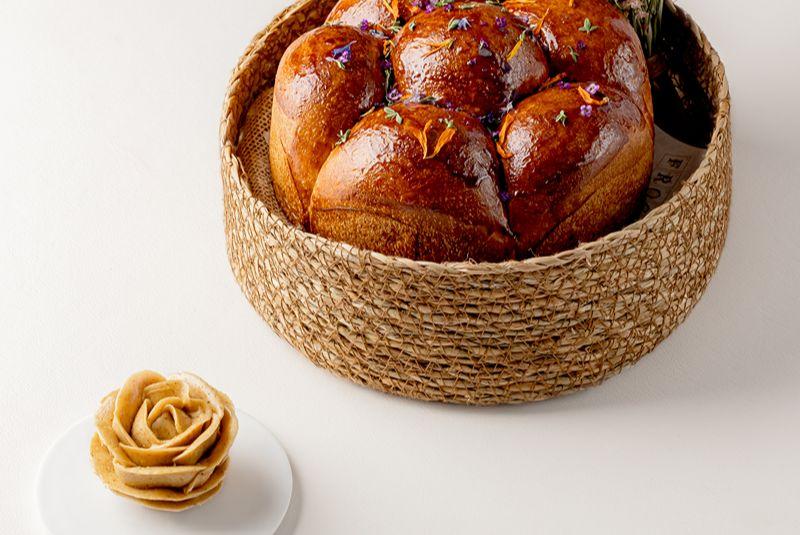
Butter at Frog is made with Cornish cream cultured in-house for two days, before it is churned and seasoned with Cornish sea salt (Image: Justin DeSouza)
Adam Handling's chicken butter has been served at Frog since the restaurant opened, capturing another cherished childhood memory: "My sister Marthe was quite a picky eater growing up and the one thing she absolutely loved was roast chicken on a Sunday. Monday was always about the leftovers – we'd shred the chicken, put it into a bread roll with loads of butter and that would be lunch."
"That's the feeling I try to preserve in the dish," Handling says. "The richness of the butter, the savoury depth of the chicken, the crispness of the skin and those comforting, gravy-like notes."
At Frog, the chicken butter arrives in a chicken-shaped jug in the bread course, whereas at his pub The Loch and the Tyne, the same butter is served on a bread board with chicken liver parfait and a gravy to make a generous starter to share.
Reflecting on butter's extraordinary versatility, Handling shares the view that it never feels out of place: "People light up when bread and butter arrive at the table – it's comforting, nostalgic and something everyone understands."
Mirazur, Menton
Butter made with cream from Froment du Léon cows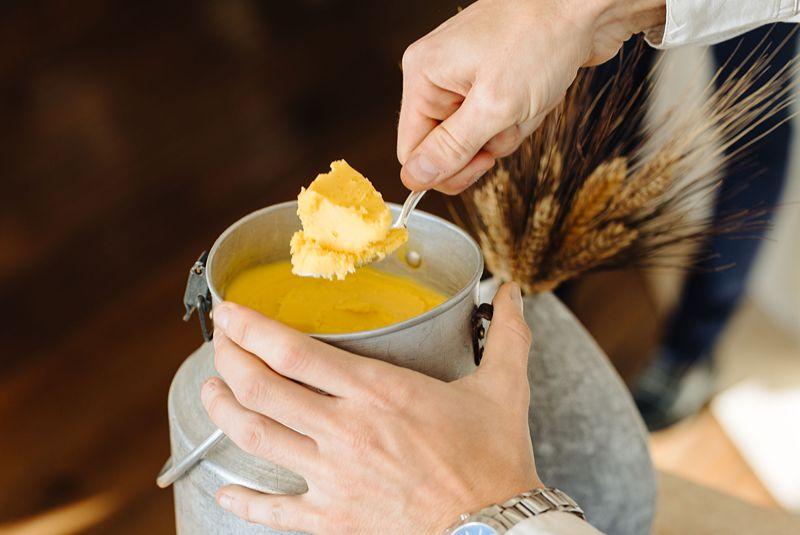
Mirazur's butter is paddled tableside, a process that begins with the butter being taken from the milk can used to transport it (Image: Coline CS)
Made by artisan Thierry Lemarchant in Pacé, near Rennes, the butter used in Mirazur's bread course uses cream from Froment du Léon cows – a breed so threatened by its low milk yield that only around 700 remain. This dairy allows the butter to be made using traditional techniques such hand-cranking a wooden churn, resulting in a product previous generations would have tasted. "It is essential to keep traditional know-how alive," chef-patron Mauro Colagreco explains. "We share this knowledge through a slightly theatrical moment: we take the butter from the biche a lait and shape it into individual mounds using the tape a beurre – a simple yet precise gesture that embodies our respect for the product and the terroir."
For all the myriad paths chefs take with butter today, its enduring power lies in its capacity to allow exceptional ingredients to speak without interruption. As was established in medieval Saxony, and affirmed in today's top kitchens, food is better with butter.
Discover more fantastic bars, restaurants and hotels with 50 Best Discovery, and start planning your next adventure.